
The Power of Knowing When to Walk Away

Book Reviews
Looking for a book to read?
Look no further.
I have been a quitter all my life. I don’t think there’s anything I’ve started and finished – unless it’s a piece of chocolate. With the result, I’m a jack of all trades and master of none. It is therefore, no surprise to those who know me, that I got attracted to a book like QUIT.
For the past several months I’ve been distracted with my mother’s health and have been literally skimming through books. I stopped buying books several years ago when I found that I rarely went back to a book after I’d finished reading it. Worse was when I abandoned the book half-way through and let it collect dust on my bookshelf till finally it found its way to the second hand dealer’s shop or just chucked into the dustbin. So I decided to borrow books instead and then buy them if I felt they deserved a place on my bookshelf.
I didn’t have time to go to the library, nor the bookshop so I was scouting around the house looking for a book to read. Now Prima Donna is a voracious reader and she is always seen with her nose in a book . I was quite surprised to find this book QUIT lying on her table. She is the last person I would have imagined reading this book, believing so strongly as she does in the adage ‘try, try till you succeed’.
Determination to hang on, and go ahead regardless that often brings us to our ruin than success. This is essentially the message that Annie Duke gives us in this book- quitting is ok. Nay it is often imperative to quit in order to go ahead.
Annie Duke is a professional Poker player and like all gamblers, knows when to quit. It is essential to know when to fold a hand or when to carry on. Thus she is the best equipped to give us tips on when it is alright to quit.
In this well researched book backed up by powerful examples from studies of well known psychologists, behavioural scientists and economists, she explores the downside of not knowing when to quite.
Why do we not quit?
- Misconception between Hero v/s loser and grit v/s giving up
All of us have been encouraged to give it our best shot. Be it a relationship, a project, or a career option, we are told that quitting is equivalent to losing, the refuge of cowards. And obviously, none of us want to lose. A person who refuses to quit is remembered as a hero even if he dies in the process while a person who quits and lives to attempt what he had abandoned or quit the first time, is considered a loser till he wins the second time. And if he quits altogether, he isn’t even remembered as an also-ran. It is this fear of being labelled a loser that often makes us reluctant to quit.
2. Fear of wasting time and money already invested
Be it a school exam or a simple 100 m run, all of us have spent time, effort and perhaps money preparing for it. And the more the effort spent in preparation, the more reluctant we are to quit. Thus Annie gives us examples of alpinists insisting on climbing to the top and dying in the process, businessmen sticking on with a losing business and eventually going bust and the most fascinating story of them all- that of Maya Shankar who had to quit several things to eventually get what she didn’t even know she was going to achieve!
3. Fear of losing one’s identity
Many of us are so invested in the identity we have created for ourselves ( teacher, skater, alpinist, writer, friend of XYZ) that we cannot imagine living a life any other way. Thus we have sportsmen refusing to quit playing professionally because without the sport they are identified with, they would become Mr. Ordinary. They would rather play till forced to quit because of injury or sheer burn out.
4. Slow and steady wins the race
Brought up on the story of the tortoise and the hare, this doctrine is so deeply rooted in our DNA, that we refuse to quit. We would rather accept any impediments in our progress with the hope that things will get better than quit when the going gets tough.
But, why then, does Annie Duke say it is ok to quit?
- When you are so determined NOT to quit, you fail to see the other opportunities that may work better for you.
- Goals can change so you can change too. So when your goal changes you can quit the path you’ve taken to reach the goal.
So for all those who thought that grit and valour is better than being a quitter should read this book. It will save you many agonising hours of ‘wasted effort’. It will also help reduce the guilt that you have taken the easy way out by quitting.
In actual fact, you have taken the harder option of quitting.
To read or not to read ?
This is a book that should be compulsory reading for us all. It is a good insight into human behaviour and questions several behaviours that are now considered outmoded and irrational.
Even though it is non-fiction, and has a lot of references to published studies ( I find attributions rather distracting while reading) it is light reading and interesting without being preachy and evangelical.
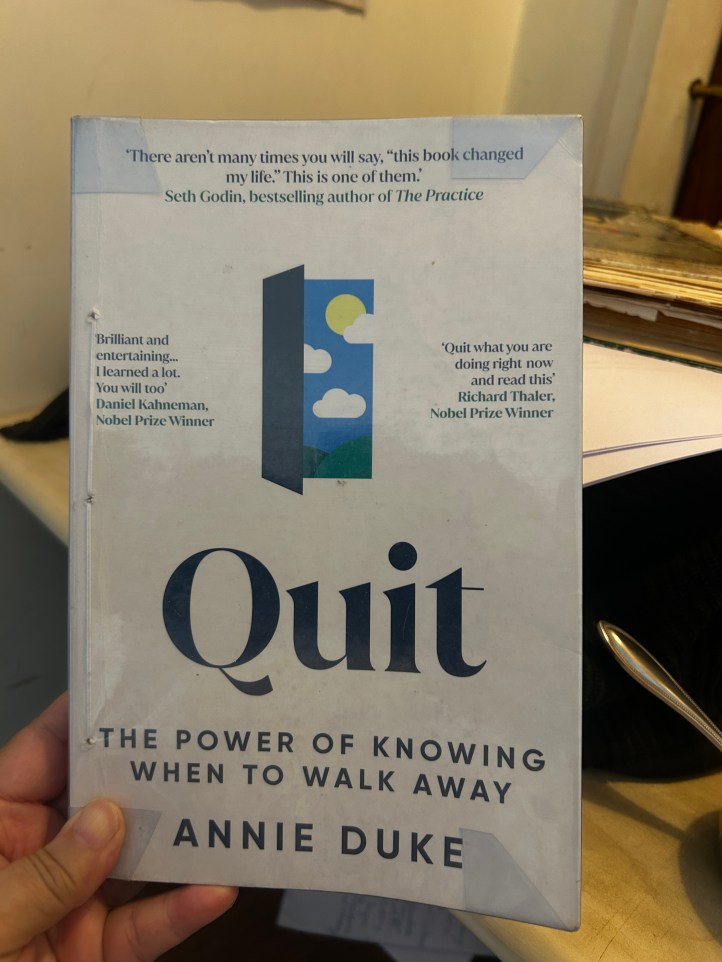
QUIT : The power of knowing when to walk away
by Annie Duke
Ebury Edge/Penguin Random House
Have a great Sunday.
Ciao,

 Twenty- five Seven
Leave a comment