

There is a long coast line along the west of India – starting from Gujarat, and going down Maharashtra, Goa, Karnataka all the way to Kerala.
This narrow strip of land suqshed between the Sabyadri mountains and the Arabian Sea is lush green for most parts of the year with rain pelting down in the monsoon months. Nothing much grows there apart from mango, coconut, cashew nut and rice. There are some other indigenous plants too like Kokum (garcinia indica), jackfruit and banana. But by and large the mountains and the sea made it inaccessible for years, leaving it isolated and underdeveloped for years. It was no wonder that people migrated to seek their fortunes elsewhere.
But ever since my mum came back from her trip to the West Coast, she couldn’t stop raving about how fabulous her holiday was. As far as I knew, she had just spent a weekend at a homestay in Harnai Beach and had enjoyed the seafood and the company of a couple of friends but came back as ecstatic and fascinated as though she’d returned from the West Coast of America!
I had to find out for myself.
So now, after half a day at Alibag, it was time to move south towards Ratnagiri, the land of my ancestors.
Look before you book
I didn’t have much time to do any research on Ratnagiri. All that I knew was that my ancestors came from the area. My parents had once visited our ancestral village and I was fascinated to know that there is a place on this earth where everyone ( or almost everyone ) shared my surname!
But I wasn’t really going in search of my ancestral village. I just wanted to spend a few days away from the hustle and bustle of Mumbai, relax and enjoy the cool breezes of the West Coast. We weren’t looking for a place on the beach. Nor were we looking for a fancy hotel. All we were looking for was a decent homestay .
Sadly, the homestay options offered by the travel agent didn’t quite make the mark so we were booked in the Dio Reggalo Theme resort which was perched on a hill 17 Km away from the city. Not only was this hotel inconveniently located, it was very poorly managed.
With no signage to guide us, and no lights to see where we were going, we completely missed the Reception. And when we went back to it, the ‘manager’ started spraying some mosquito repellent and told us not to come inside. But since he was expecting us, he sent the bell boy to show us our room.
We were allotted a room in a cottage on the top row. This was highly inconvenient and dangerous for two old ladies to go traipsing around slippery slopes in the dark. The room didn’t have a single plug point that worked and such poor lighting that we had to use our phone torches to find the plugs and switches. When we asked for a change of room, the bell boy was shocked that we wanted to move because this room had a television that worked!
The staff was poorly trained and had no idea of what hospitality meant. The restaurant had an exhaustive menu but half the items weren’t available.
So a word of warning: call up the hotel and check if it meets your requirements. Find out all the amenities available and the general layout of the property.
The Palace of A Burmese King
The disappointment of the choice of hotel didn’t dampen our enthusiasm to visit the city. After all, we hadn’t really come to Ratnagiri to sit around and have chai in the verandah. We just wanted a spot from where we would visit other places nearby.
The sky was still overcast and threatened to rain so after a quick breakfast, we made our way to the city to see one of its main attractions – the Palace of Thibaw, the last king of Burma.


At first glance, the building looks impressive but must have been a real comediwn for King Thibaw who lived here under house arrest for the last six years of his life. De-throned and deposed, the last king of Burma was sent to far off Ratnagiri, with his second wife who was pregnant at the time, a place so isolated and desolate that he would truly be lost to his people and the world. Deposed in 1885, the royal family lived for 24 years in another house till the Palace was completed in 1910,
Sadly, he lived there a broken man till his death in 1916. Thereafter his family moved back to Burma leaving behind a daughter ( Tu Tu) who had married a local palace retainer. Till today her descendants live in Ratnagiri in relative poverty quite unmindful of their royal lineage.
After the royal family left the building, it was used as a government office for a while and then as a Polytechnic till its present avatar as a museum.
Recently, the government has made some efforts to refurbish the building and the roof has been re-tiled and some of the original Burma teak wood doors replaced.
The interior, however, is a real let down. An old caretaker makes you sign a book and pay a fee of Rs. 30. There is no one to take you around and the caretaker warned us not wander off as much of the edifice is crumbling and areas are cordoned off. There are some rooms on the first floor that have sculptures that were found in the area but of no relevance to the King. Another room has a portrait of the solemn looking king, and a carved chair but is totally inaccessible for a close look.
But the Government seems to be serious about restoring the palace from the Sound and Light show slated to be held after the monsoon. In front of the mansion you can find lights and benches waiting patiently for the show to begin.
It will be quite awhile before the building is restored to its orignal form and till then, a visitor will be welcomed and shown around by a few enthusiastic stray dogs and a desultory watchman.
The Royal Tombs
We visited the tombs where he and his wife are buried but once again, the complex had neglect written all over it. In 2016, a hundred years after King Thibaw’s death, his descendants from Burma were allowed to visit the tombs to pay their respects. At that time there was a cursory spruce up but soon enough they were left to descend into ruin.

Isn’t it a pity that the King of Burma, head of one of the richest provinces of the British Empire lies in a badly maintained tomb , un-marked, ignored and neglected in the middle of the city, amidst crumbling apartment blocks?
The tombs were inaccessible with tall grasses and weeds growing all around. We did manage to enter one compound but were scared to venture close because of the mossy tiled brickwork that may have had us slip and fall!

Birthplace of a freedom fighter
While the King of Burma was exiled to Ratnagiri, one of Ratnagiri’s famous sons was imprisoned in Mandalay ( Burma). Was it by coincidence or design?
Keshav Gangadhar Tilak known as BAL Gangadhar Tilak was born in a modest house that is restored to its pristine glory.
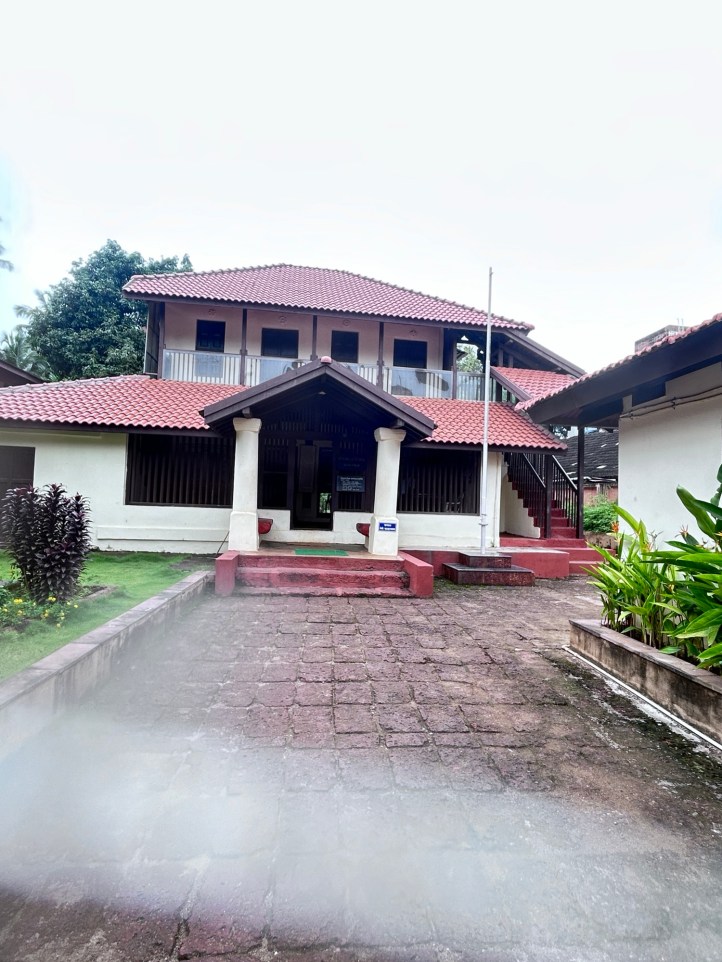
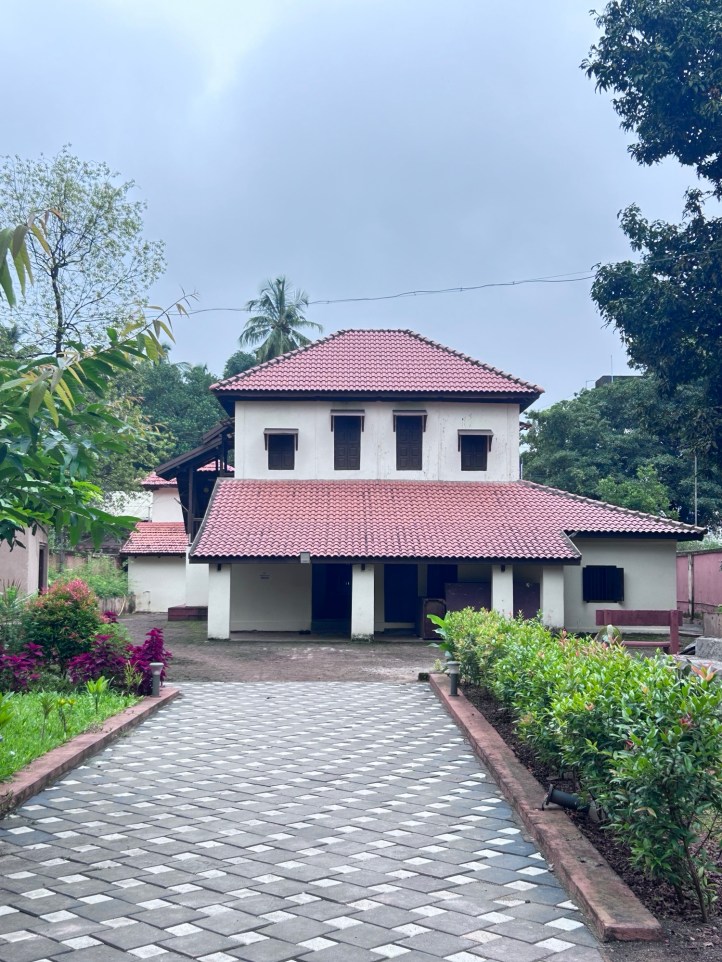
Well maintained and well kept it is memorial that showcases his life and involvement with the freedom movement.
The house opposite which is still in use remains a good example of Konkan architecture in the late 19th century.
I wish that both Thibaw’s Palace and Tilak’s house were recreated to show how they actually lived in those times. If nothing else, a well informed guide would have added value to a tourist’s visit.
Konkan Angan
It was time for lunch and taking a tip from Trip Advisor, we selected the #3 restaurant on their list since that seemed to be the only restaurant offering local cuisine. We drove on the highway towards our hotel and almost missed the restaurant.
It looked so different from the photos on Trip advisor which showed a decent but simple eatery with outdoor seating.
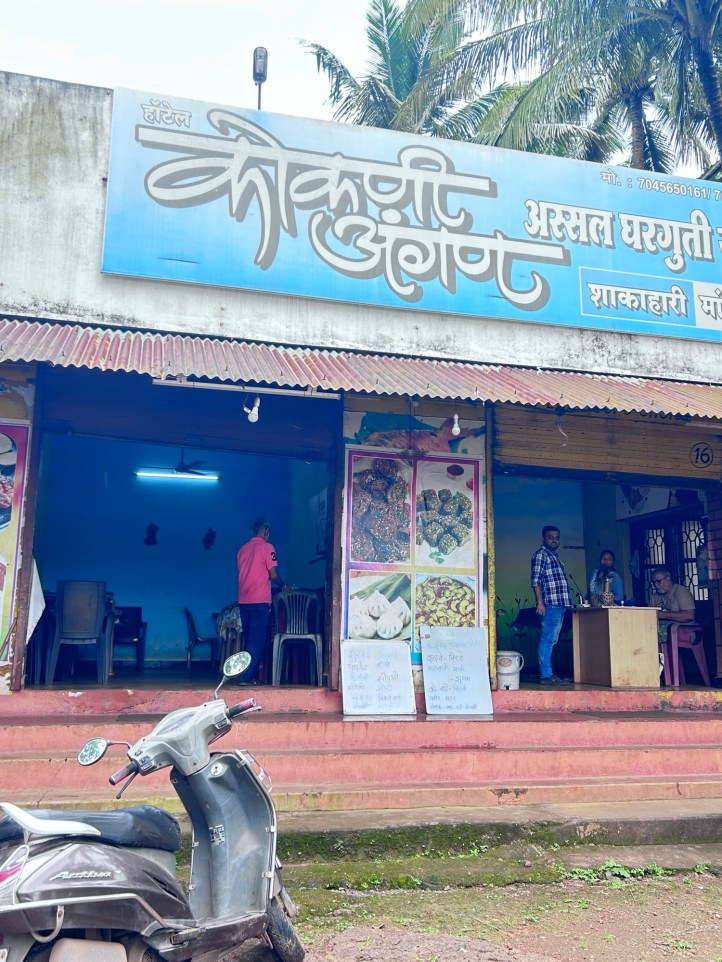
What we got instead was a non descript set of three garages in a building still under construction. . One garage and was for the general public and had plastic chairs and metal tables. The other garage to which we were invited had one table covered with a gaudy rexine table cloth and plastic chairs.
I was a bit apprehensive but Mrs B was quite confident that such a simple place would serve authentic homemade food that was tasty and fresh.
She was right as always and she enjoyed her crab curry and rice flour bhakri while I relished my freshly fried, freshly caught surmai slice with bhakri. We washed down this meal with a glass of the creamiest sole kadhi.
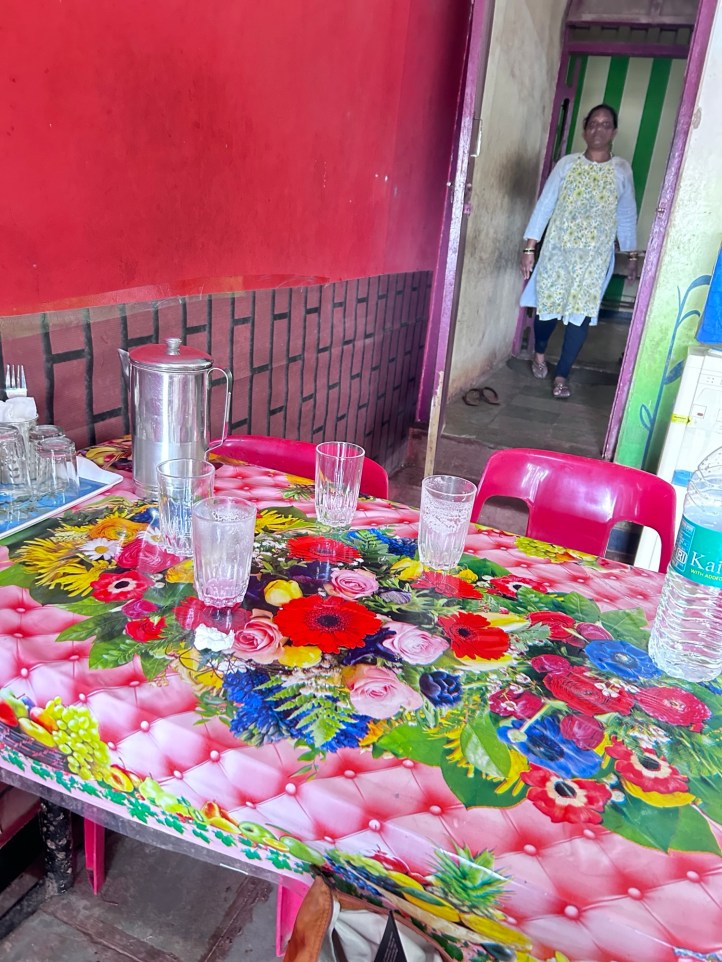
It was definitely a meal worth having and when we saw the number of people coming for takeaways and eating next door, we realised that TripAdvisor knew what they were talking about.
By this time the rain had started so we returned to our room on the hill.

By evening the clouds had descended on us. All around us was lush green foliage and a peaceful calm.
I began to understand why my mum was ecstatic about the West Coast.
Ciao


 Twenty- five Seven
Leave a comment