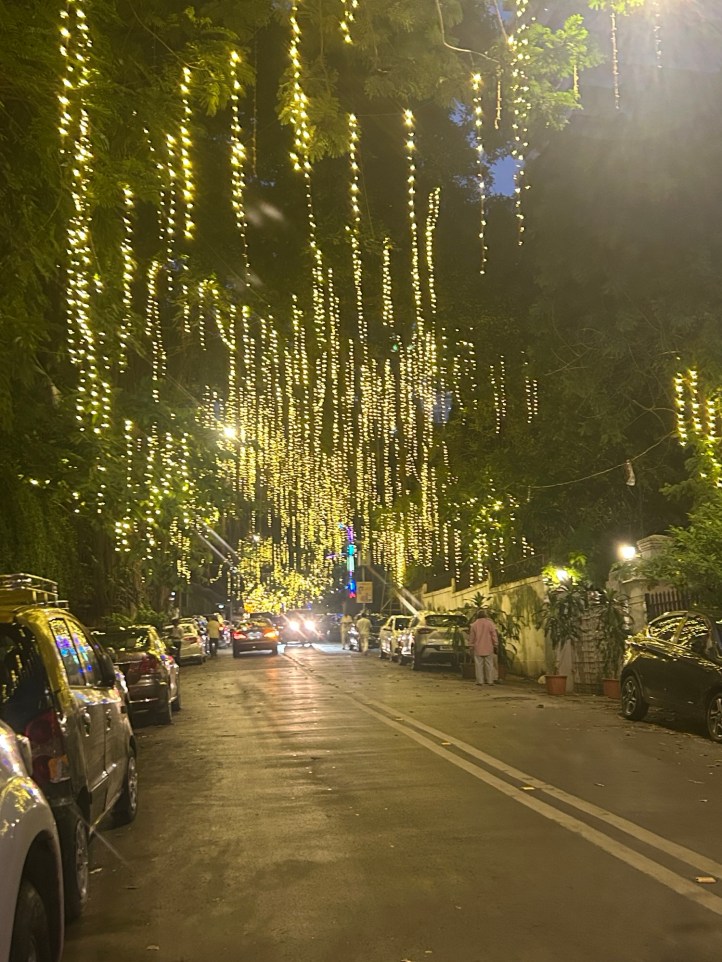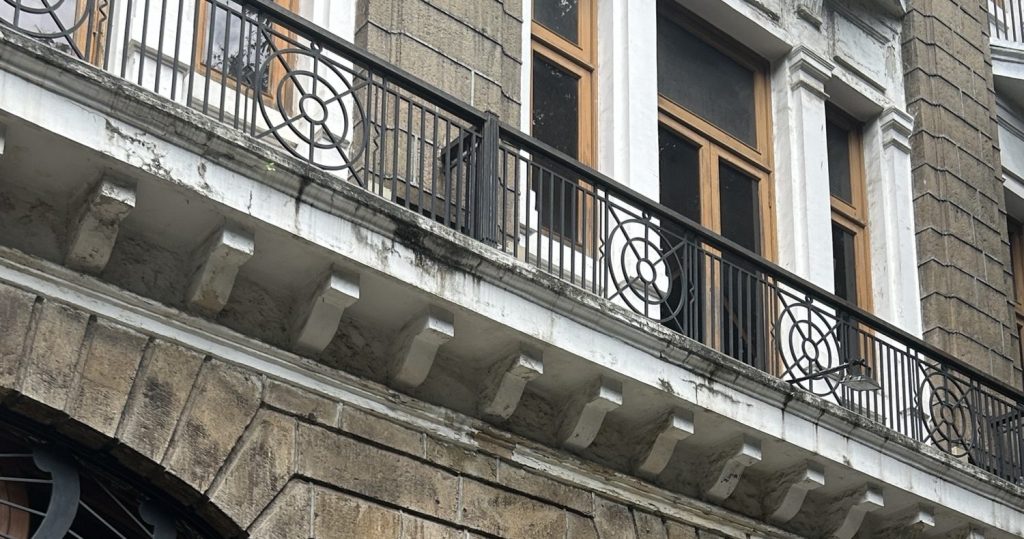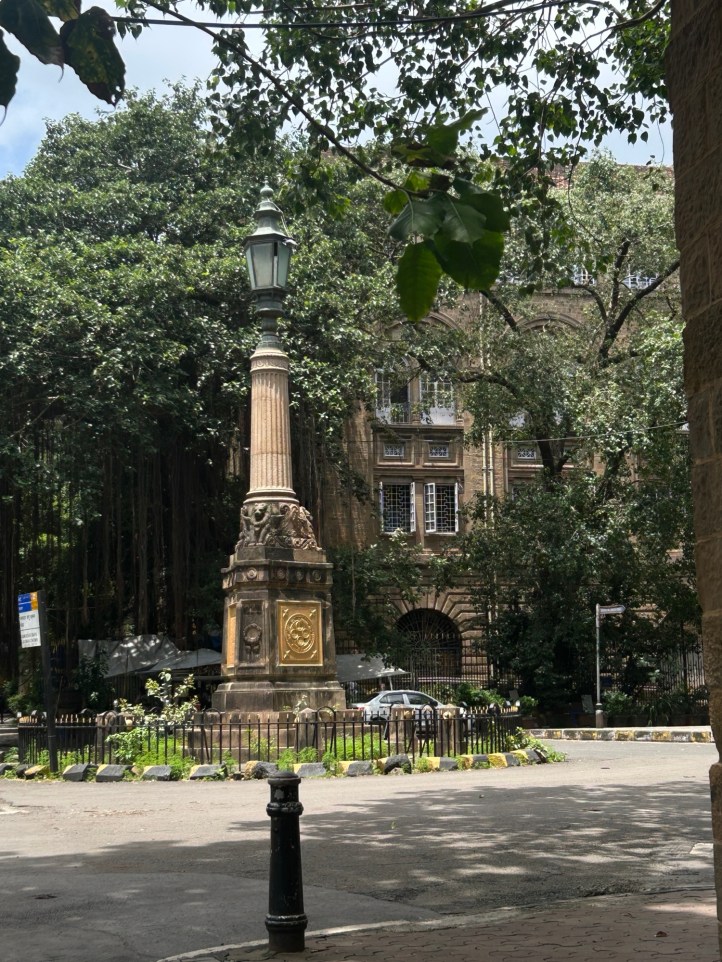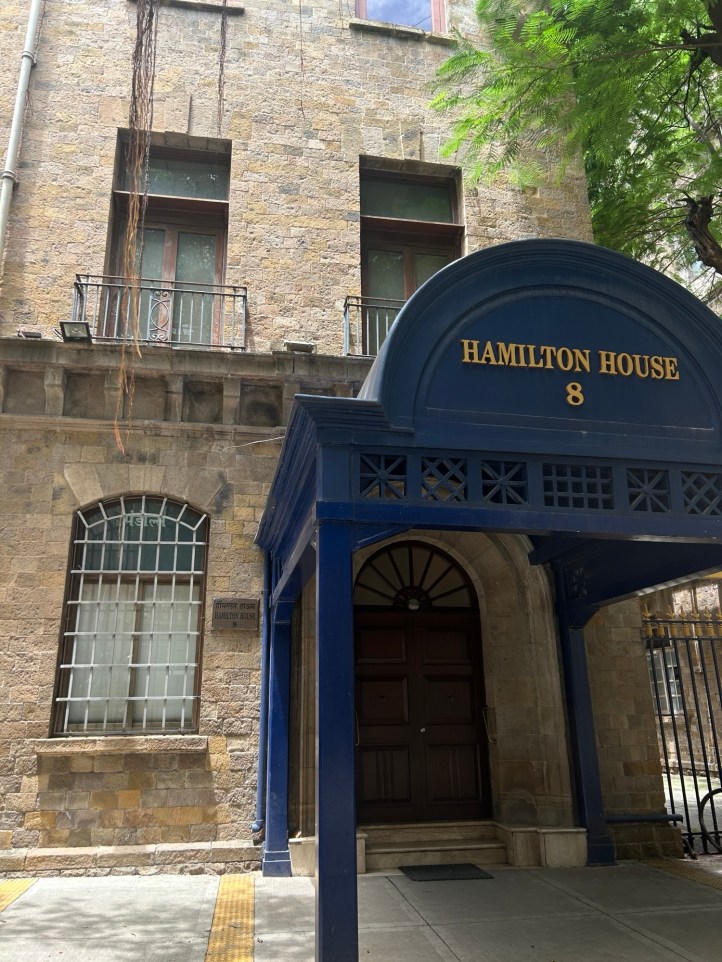
• Visitors to the city of Mumbai are amazed by its beautiful skyline all along the coast. But all of Mumbai is not glass and steel. There are some parts that still retain the buildings of the past. Yes, strange as it may sound, there are a few pockets where old villas and buildings still exist, hidden behind the concrete towers that have sprung up.

    I had always known about these villages but for one reason or the other, didn’t bother to find out more. But this Sunday, a message on a WhatsApp group mentioned a walking tour of Mazgaon conducted by a young student. Most tours are conducted during the week but this one was specifically on Sunday afternoons only, so I was hooked.

    Two magnificent lions flank the entrance of Lions’ Den, an iconic bungalow from where we began our tour.

    The sky was overcast as I left for Nesbit Road, where we’d agreed to meet, and just as soon as I stepped out of the cab, it began to rain. I made a dash for the nearest shelter and hoped the people whose entrance I stood at wouldn’t object to my presence. Many residents resent the curious stares of strangers and are also wary of potential land sharks posing as tourists.

    Tourist in my city

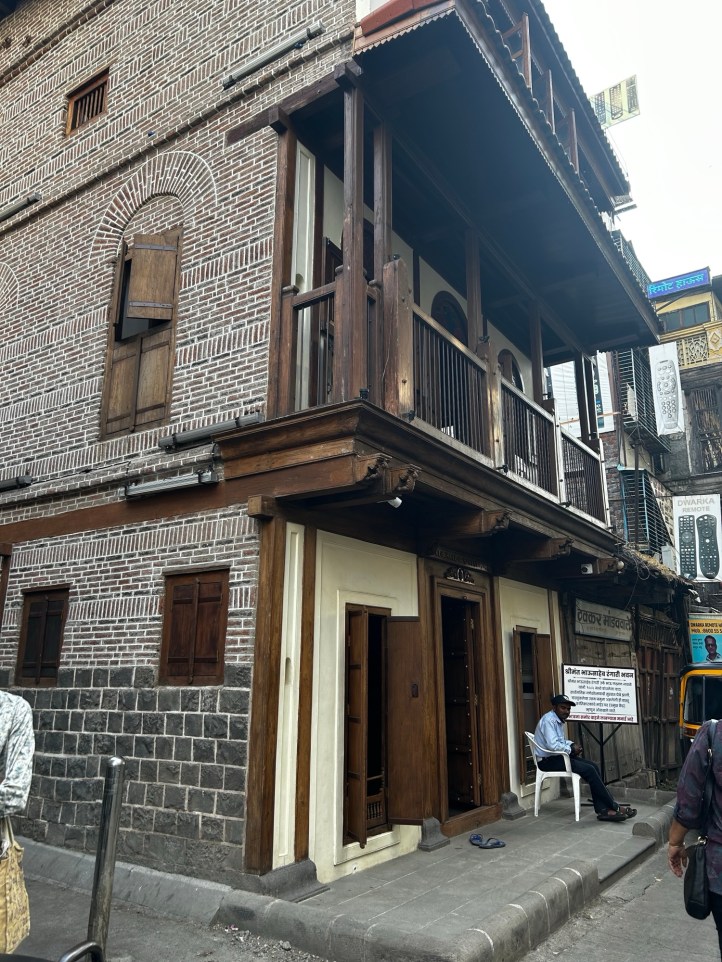
    Luckily the rain stopped as my guide came and we began our tour. Since we were going to walk up to Mazagon HIll and see the John Baptista park, the water works and the Chinese Temple, we didn’t spend too much time in the village which turned out to be Matharpacady and not Mazgaon Village as announced by the gateway erected by the local MP.

    The houses were single storied with wooden balconies, side staircases and typically Portuguese in architecture.

    Originally built in an Oart( or garden) it was famous for mango trees that fruited twice in a year, there are no traces of any greenery with its narrow lanes and quaint houses.

    Many of the original inhabitants of the village were scared away by the bubonic plague that decimated the population of Mumbai and those that survived raised the Holy Cross Oratory in gratitude.

    One of the residents who was up and about was happy to share some of the history of the village but by and large, the residents do not look kindly on outsiders and we should respect their privacy.

    So while it is worth a visit, I would suggest going with an experienced tour operator like Khaki Tours , who has taken prior permission from the residents of the village for a more thorough and rewarding trip.

    Ciao,


  • 79 years on – Thoughts on Independence Day

    Almost every day I walk past this monument built to mark the Quit India Movement in a busy park . Well maintained though largely ignored, I wonder what our Fredom Fighters would have made of the country they had fought for.

    Today as we enter the eightieth year of Independece, certain thoughts come to mind.

    I grew up in a country that had just about attained independence and was struggling with the idea of nationhood. With Socialism shaping global politics, naturally economic progress and social mobility was high on the agenda.

    Sadly, after so many years, we have made economic progress, but social inequality measures to address them. Subsidies have not removed poverty, affirmative action has not removed class distinctions, and modernisation has not increased employment, infrastructure and healthcare.

    On being Indian

    Over the years, our social fabric has evolved into a hybrid model that leaves us more confused than ever. How do we identify ourselves? By language, religion, caste, class?

    The more we try to bring order and uniformity, it seems that we are creating more chaos.

    We are still struggling with basic essentials of good living. We don’t seem to have got anything right. We have sent a rocket to Mars, we have fought and won wars, we fight and squabble over the most inane issues.

    But this is my country and I am happy and proud to call myself an Indian.

    I feel unbridled joy when I hear our National Anthem being played in cinema theatres and sports arenas. I am moved to tears when I see our men and women in uniform serving our nation selflessly. I feel happy when I show my passport at Immigration even though I know I am returning to a country that is not always perfect.

    I am coming home.

    Jai Hind today and always.

  • Floods in Upper Assam

    Floods in Upper Assam

    The monsoon has been pretty erratic this year. Sometimes it rains. Sometimes it doesn’t. And sometimes it pours so much that you wish it didn’t rain.

    Sitting in Mumbai, we have no idea of the fury of the monsoon rains. Especially in the northeast. The Brahmaputra river is the main river system in this region keeping it green and vibrant all year round. All rivers in India are considered feminine except for the Brahmaputra or Son of Brahma the Creator. Every year the river overflows causing floods and extensive damage especially when it enters Bangladesh.

    But this year, I got a first hand account of the river’s fury when Robin, a classmate of mine now settled in Guwahati with his wife Rimly, shared images of the floods in Upper Assam with our school WhatsApp group His wife, Rimly ,an amazing woman, I might add, who is an artist, a gardener and DIY enthusiast, organised a rescue mission with some of her friends.

    Helping hands

    These intrepid ladies folded up their sleeves, opened their hearts and collected a whole load of stuff ( food, clothes , blankets, medicines ) to provide some relief to the hapless villagers who literally saw their lives flowing by.

    Getting ready to leave

    According to Robin, the floods have intensified after intensive mining deforestation started. Because there is no vegetation to stop and let the water get absorbed, the water flows clean through carrying the silt into the already silt laden Brahmaputra. Tragedy

    I just had to share these images that she sent back to Robin .

    Dead bodies lying covered on the side
    Women who find and burn dead bodies

    Rimly came across these women from bengal. They specialize in searching for dead bodies. They locate and burn them. Some bodies are tied to trees so they don’t get swept swayed. Many kids have been swept away and not found.

    Actual Report from Rimly

    NEPALI KHUTI – BIHUBOR COLONY VISIT, 8 August 2026

    A Ground Report from the Flood-Affected Areas of Sivasagar district, Assam.

    When the waters rise, the true measure of humanity is how we stand with those who are left behind.

    Our journey to Nepali Khuti and Bihubor Colony in Sivasagar was not simply a relief trip. It was an encounter with the harsh reality of what flooding means for ordinary families. The devastation followed by complete desolation.

    As we travelled towards the affected areas, the landscape itself began to tell the story. Roads and pathways were waterlogged, homes and surroundings bore the unmistakable signs of inundation, and normal life brought to a standstill. Household items strewn around completely damaged, people taking shelter in the makeshift tents on the streets holding onto next to nothing.

    But it was when we reached the affected communities that the magnitude of the situation truly became apparent. A lady sitting in front of her inundated house with nothing left but the foundation. Yet she was smiling while we were trying to fight back the tears. An octogenarian depicting how the flood waters surged into their area and that he had never in his lifetime seen such fury of the otherwise calm and quiet Dikhou River. Yet another elderly man saying he lost everything including his family. He told us smiling that he has gone back to zero.

    What we saw on the ground

    The floodwaters have disrupted almost every aspect of daily life.

    Families are struggling to protect whatever belongings they have left. People are now totally dependent on outside assistance for essential food and other necessities. For those whose homes and livelihoods have been affected, the uncertainty of what comes next is perhaps even more difficult and terrifying than the flood itself.
    What can we do ? How to rebuild their lives?

    The photographs and videos we captured during our visit are a small glimpse of that reality.

    But behind every image is a human story.

    An elderly person worrying about tomorrow.

    A family trying to save what little they have.

    Children whose normal routines have disappeared.

    People waiting patiently for help while dealing with circumstances they never asked for.

    Our small effort

    We went as a group of volunteers with a simple objective—to reach out to people directly and provide whatever assistance we could. To tell their story. And just to be with them. We felt so small after seeing all of the devastation, felt helpless yet tried to console them that this too shall pass.

    We know that one relief trip cannot solve the enormous problems created by this flood.

    But relief is not only about the quantity of material we can provide.

    It is also about showing up.

    It is about telling people:

    “We see you. We hear you. You are not alone.”

    Our visit to Nepali Khuti and Bihubor Colony reminded us that communities become stronger when people come forward for one another.

    Beyond the floodwaters

    The immediate need is relief—but the challenge will continue even after the waters recede.

    Homes and surrounding areas will need to be cleaned. Knee deep mud and silt will have to be removed, houses repaired and rebuilt.

    Livelihoods will need to be restored.

    Families will need continued assistance.

    Children will need to return to school.

    And communities will need to spend time to rebuild their lives.

    Therefore, our effort should not end with this visit.

    A message to everyone

    If you are able to help, please do.

    You can contribute through volunteering, essential supplies, financial assistance or simply by spreading awareness. Please be there for them. They need you at this time of the hour.

    Every contribution matters.

    Every helping hand matters.

    Every act of kindness matters.

    Our visit to Nepali Khuti and Bihubor Colony has left us with one very strong message:

    Disasters may divide us geographically, but compassion brings us together.

    We came to help. We cried. They made us smile.
    We returned with something more valuable—a deeper understanding of the strength, dignity and resilience of the people we met. They are still smiling. All we need is to be with them, even a small word of consolation helps.

    Nepali Khuti and Bihubor Colony—your struggle has been witnessed. Your voices deserve to be heard. And your journey towards recovery must not be walked alone.

    Standing with the flood-affected communities of Sivasagar and Charaideo district.

    From LHSF_foundation
    8 August 2026

    A heart wrenching story

    Every year the river overflows but this year the tragedy was brought home by the active participation in relief operations by Rimly and her friends.

    Without so much as batting an eyelid, these ladies quickly got themselves organised, collected essentials and got going.

    Ciao

    P.S. This work is not over yet . Rimly and her friends are going back with more packages for yet another round of relief work

Design a site like this with WordPress.com
Get started