
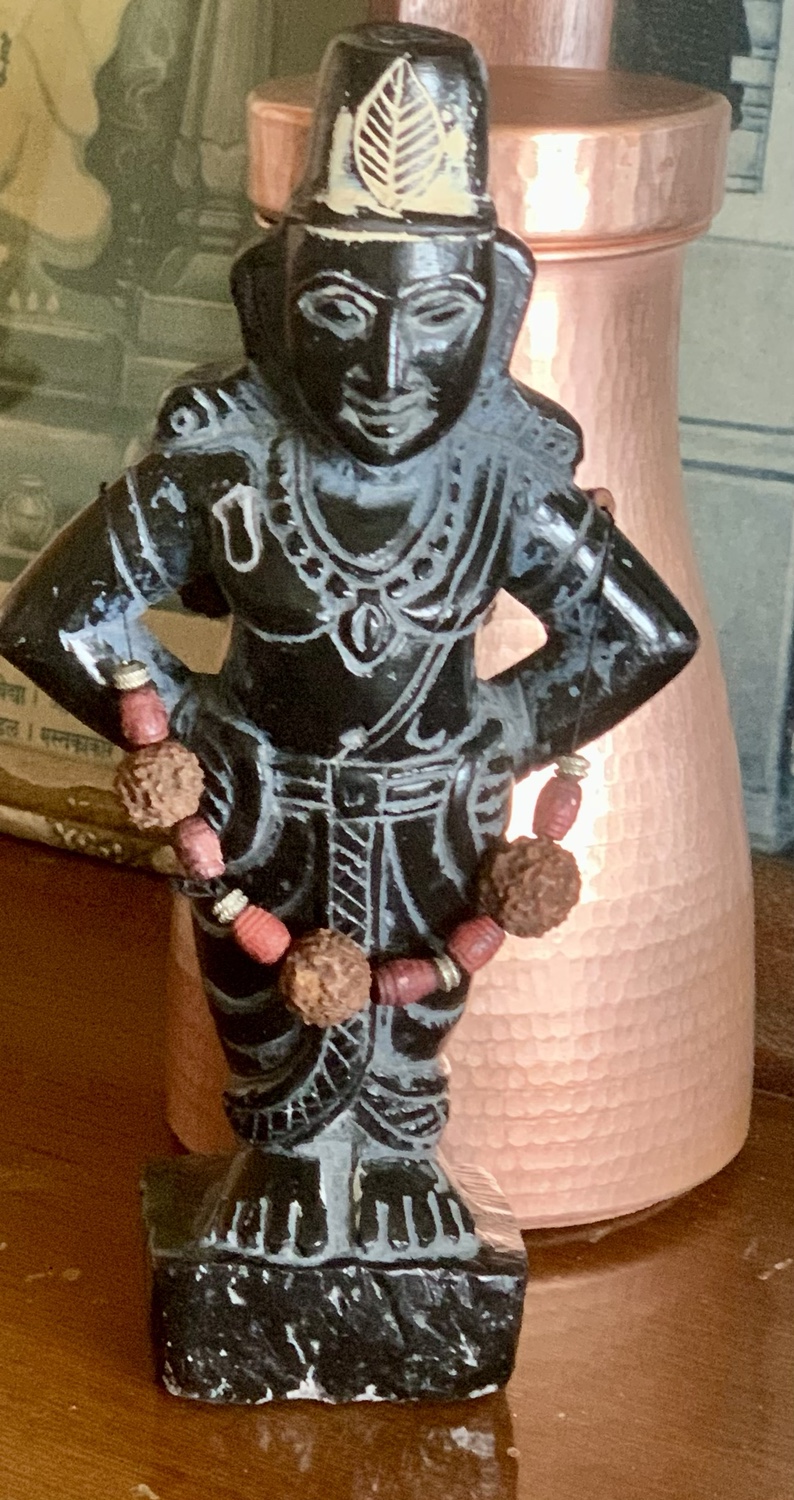
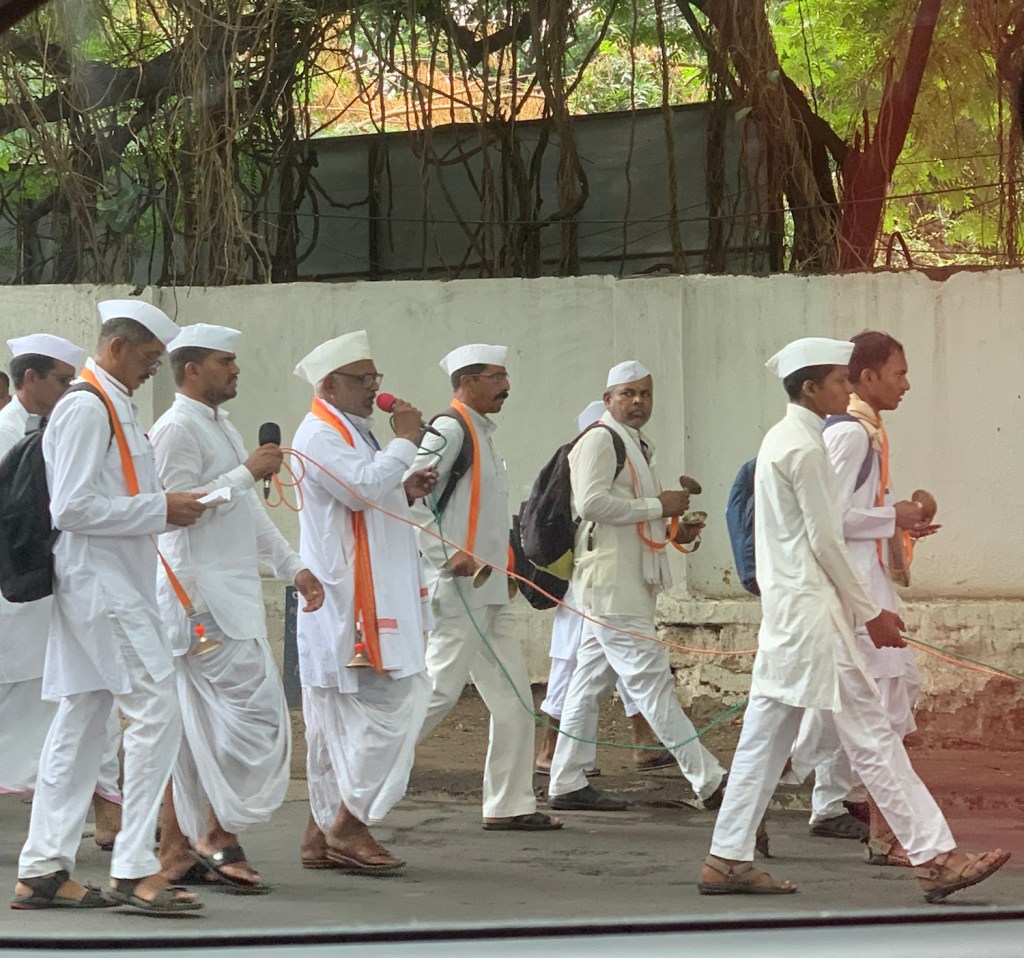
On the banks of the river Bhima is the temple town of Pandharpur. It is known for the Krishna temple of Vithal or Vithoba where Vishnu or Krishna is standing on a brick.
This part of the river which looks like the crescent moon is also referred to as Chandrabhaga in the hymn that sings the praises of Lord Vithoba.
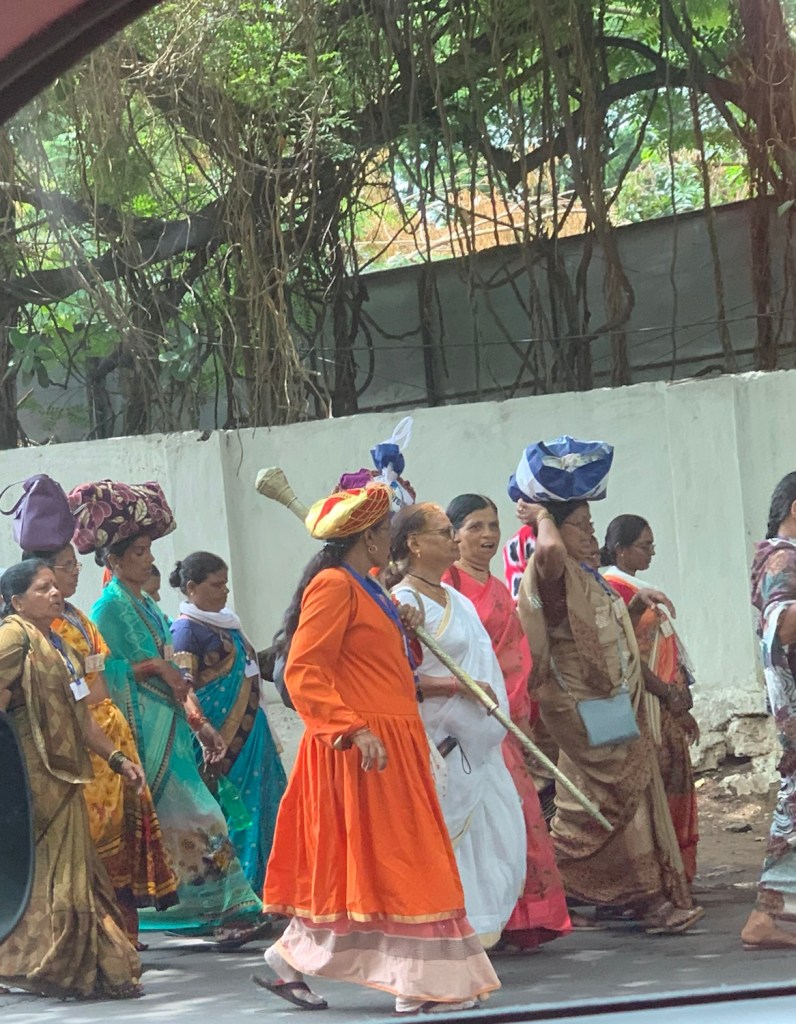
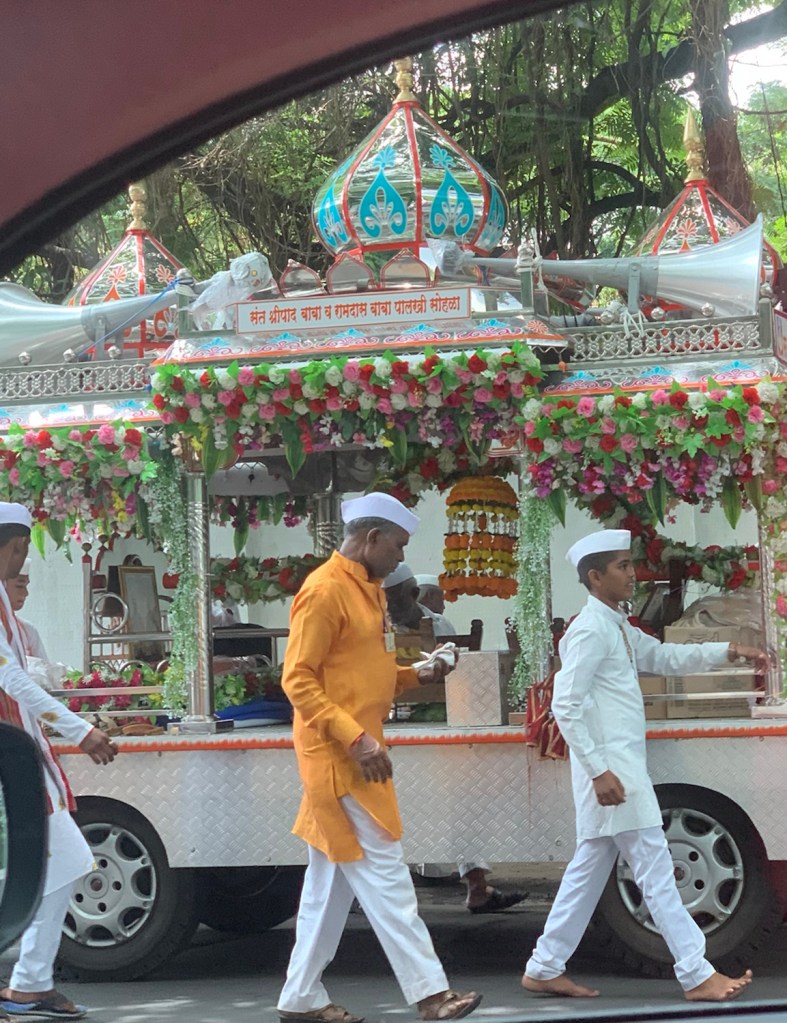
These Varkaris or Pilgrims start out from Alandi ( another temple town near Pune where St. Dnyaneshwar attained Enlightenment or state of Bliss) for a 10-day pilgrimage singing praises of the Lord as they walk along.
Their goal is to reach Pandharpur by Ashadhi Ekadashi ( the 11th day of the brighter half of Ashadh, the 4th month in the Hindu calendar). This is the first day of Lord Vishnu’s annual nap which lasts for all of four months. At the end of this period ( Chaturmas ), the pilgrimage is again repeated – this time to welcome him back.
About thirty years ago, I realised that my daughters’ birthdays coincided with these Ekadashis. One was born on Ashadhi Ekadashi while the other just two days prior to the one in Kartik. Firmly believing that everything happens for a reason, I took this as a sign to observe Chaturmas.
This also sparked the idea of going for a pilgrimage at least once in my life. Rather selfishly, I also thought it would help in weight management, a battle that I seem to be losing by the day.
So I began scouting around for Pilgrim teams to join up with and a suitable travelling companion. My mum gamely agreed, tempted by the thought that we could talk uninterrupted for 10 whole days!
He who would valiant be
My mother who is more resourceful than I (she also had more time on her hands ) identified a group of people starting from Pune she thought we would be comfortable with since the team leader was an ex-colonel’s wife and would, therefore , have would have People Like Us.
So off we went one afternoon to the heart of old Pune, where the Colonel lived in his ancestral home post-retirement. We rang the bell and were received by a stern lady whom we couldn’t quite place as the mistress or the maid. She, of course, stared back equally confused, unaware of who we were and why we were disturbing her siesta. So we rather hesitantly asked if this was the home of Col. X and if so, we wanted to inquire about the annual pilgrimage to Pandharpur.
The lady immediately tucked her sari in place and with half a reluctant smile bade us come in, introducing herself as the colonel’s wife and invited us in. She directed us to two uncomfortable, small stools in a badly lit room, with a table fan whirring noisily in the corner and we told her what we had come for. Looking rather disparagingly at us she began:
“Well, let me tell you that this is not an adventure or a pleasure trek. Our team is only open to genuine pilgrims. You can’t come if you aren’t believers. You will have to walk only in saris and you will have to only sing hymns or prayers. No small talk is allowed.
We walk in stages – the first before sunrise when you have to wake up, have a quick bath, ( all in the open fields, mind you) wash your clothes and after a cup of tea, load your wet clothes in a bucket and begin walking. The bucket will be kept in a truck which will carry everyone’s belongings.
After two hours we stop for a breakfast break where you eat the food that you have to carry with you. Then we walk for around three hours before we stop for lunch. This is a long halt where we rest till tea. We generally stop in school compounds or open tented spaces where volunteers give us food and water. During this time you are supposed to dry out your clothes. And I forgot each person is allowed only half a bucket of water for bathing and washing clothes.
After tea, we begin our last leg for the day before we stop at a local municipal school for the night. Once again, dinner is provided by volunteers. Each pilgrim is allotted a space of 2’x 5’for rolling out bedding with just about a foot between each bedroll. Needless to say, this is a community hall so you can’t choose who gets to sleep next to you !”
That did it for us and I could see Mrs Colonel barely hiding her smug smile as she saw us to the door. She knew she had discouraged us sufficiently for this time if not for life.
I couldn’t help but wonder how so many people undertook this pilgrimage if it was so hard. I had heard of a few overseas students who had joined in for the experience and surely they couldn’t have been believers in their jeans and sneakers? How come they were allowed to participate?
Later that evening when we recounted our encounter to General Patankar, who had invited us over for a sundowner. He had a hearty laugh.
“Forget those crackpots,” he told us, “get yourselves a trusted attendant and a comfortable Tempo Traveller of your own. Loosely attach yourselves to a group of Pilgrims and follow them on the road. And at sundown have a nice chilled beer and bully beef sandwiches before you tuck yourselves in your sleeping bags inside the clean, cosy Tempo.
Tempting as it sounded, the General’s idea seemed far too hedonistic and we dropped the idea completely.
Post script
When we did finally make it to Pandharur about twenty years later, the general was long dead as were the colonel and his wife. We drove down one December morning when the weather was fine and the temple town was free of pilgrims. Not only was it comfortable but over in half a day!
The temple was empty and surprisingly clean. My mum and I happily went in while my dad glowered outside ( his interest in temples is restricted to architecture, historical significance and folklore). Thrilled at last to be in front of the idol that I had always longed to see, I closed my eyes in a state of calm. Whispering my prayers of gratitude, the peace was suddenly shattered by a strange body smell as something rough brushed against me. I turned around to stare and glare my disapproval as my ears were assailed by loud claps and the raspy chanting of “Vithala, Vithala”: it was a huge, fierce looking country woman with her big eyes and a red dot covering most of her forehead. I requested her to be a bit quiet in her worship but she rudely dismissed it saying “You pray the way you want to!”
So it seems that the rough and tumble of the pilgrim’s way is not meant for people who prefer a more sanitized and comfortable journey.
Over the years I often thought about doing the pilgrimage because there are enough people doing it from various parts of Maharashtra. I regret not being tenacious enough to find a team that I would be comfortable with. But, I also wonder why the colonel’s wife was so adamant about dissuading us from the Pilgrimage itself. After all, the pilgrimage is twice a year and there are hundreds of pilgrims on the road. She could easily have told us about another team.
Often times I wonder if it could have had anything to do with the fact that she was one of the prospective brides suggested to my father in her young days and still bore a grudge against him for turning down the proposal?
Ciao


Leave a Reply