• Getting ready for Kumbh

    The Kumbh Mela ( or the Festival of the Sacred Pitcher as it is called on the official website) is a gathering of devotees at a special time when the planets are favourably aligned to bathe in the rivers at four sacred places : Nashik, on the banks of the Godavari, Ujjain, on the banks of the Shipra, Haridwar on the banks of the Ganges , and at Praygraj at the confluence of the Ganga, Yamuna and the underground Saraswati.
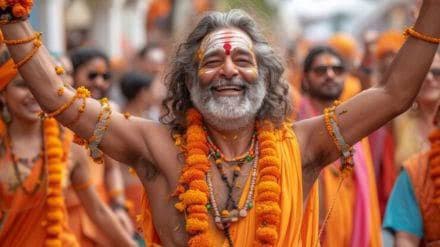
    These are the places where drops of nectar from the pot fell during the fight between the Gods and Demons. The festival is held every four years in rotation and this year it is being held in Prayagraj or Allahabad.

    This is a special Maha Kumbh which occurs once every 144 years when all the Planets are lined up in a celestial Parade of the Planets.

    A chance remark often sets forth an amazing journey.

    If I’ve been silent so far, it’s because I’ve been preoccupied with many things ( nothing new really). A chance remark made at a casual dinner earlier this month set off an amazing experience

    I have always been fascinated by the crowds that Hindu temples attract. Granted there are so many of us in this most populated nation on earth, but nowhere have I seen such frenzy and fervour as I’ve seen in our temples and religious events. So this year when the Maha Kumbha was announced, I’ve been curious about going there.

    So my friend S who is very adventurous and been on many pilgrimages said she was willing to take the plunge as long as I did.

    S set about in her meticulous way of contacting her travel agents and fellow satsanghis who were going to the Kumbh at various stages.

    Everything was set and yesterday we had a meeting to finalise details about our journey, our stay and the places of interest we would like to visit.

    Last Minute hiccups

    All was fine till a friend called up to say that all roads to the Kumbh would be closed 24 hours before we would be scheduled to leave.

    And in all likelihood the train we had booked for our onward journey would be summarily cancelled literally leaving us high and dry on the station platform( if we managed to get there in the first place).

    Thus began the scramble to co-ordinate with an ordinary citizen on the ground who was definitely more accessible than the official Kumbh site which is manned by a truly idiotic Chat bot and whose telephone numbers do not exist.

    While we are waiting for further information I get a message from a friend informing me that all roads will be closed for three days prior to

    • 27 th Jan because Amit Shah would be visiting
    • 5th Feb because our PM Mr. Modi is visiting
    • 10th Feb because our President Smt. Murmu is visiting
    • In addition 26-27 February is Maha Shivratri so it will be over crowded.

    So what does that leave the ordinary practising Hindu with?

    Quite frankly, I am disgusted with how VIPs get away with disrupting ordinary citizens’ lives. And to think we have voted them to power to represent us!

    I am now in a quandry whether I should go or not though S has assured me that I should leave all the worrying to God. If He wants us to visit, He will make sure that we get there and back safe and sound.

    What would you do in my place?

    Ciao

  • Winter’s Harvest

    Our Mumbai winter which is getting rarer and rarer is really the best time to be in the city . Despite the horrid traffic that increases tenfold and the subsequent pollution I like our Mumbai winters because of the fresh fruit and vegetables in the market .

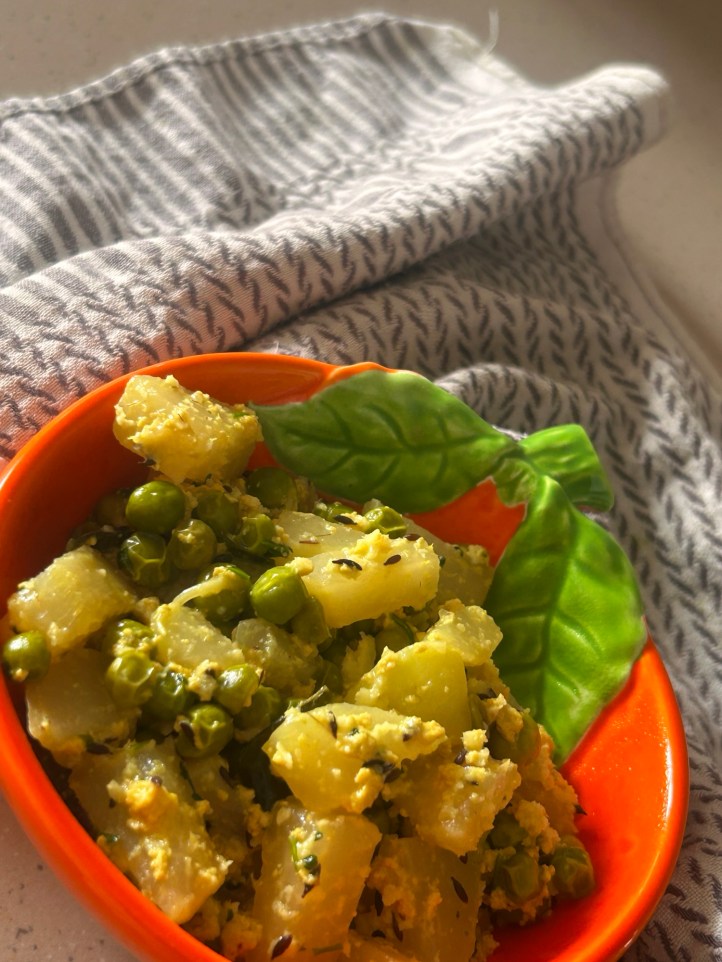
    Kohlrabi or knolkohl is one of the rare gems that Winter gifts us Mumbaikars. Not many people know that this turnip like vegetable is packed with a punch . I like to cook it with another winter treasure – fresh green channa or green chickpeas. This plant is particularly grown in winter to replenish the soil with Nitrogen.

    Unfortunately, these little peas are tedious to shell so today I made my favourite winter special with green peas . These too are in abundance and are specially sweet and juicy.

    Green peas and kobl rabi

    To make this I used

    1 small kohl rabi

    1 cup shelled green peas

    1 tspn ghee

    4 curry leaves

    1/4 tspn turmeric powder

    2 tbspn fresh grated coconut

    1 tbspn finely chopped coriander

    What to do:

    Peel the kohl rabi and cut into small oblong

    pieces. Keep in water to avoid discolouration.

    • Heat the ghee in a flat bottomed pan.
    • Add the jeera and allow to sputter.
    • Lower the heat and add curry leaves, turmeric and hing.
    • Add in the peas and kohl rabi and stir before adding milk.
    • Cover with a lid. Lower the heat and let cook till the vegetables are soft.
    • Add coconut and coriander and serve with hot Chapati.
  • The sacred thread

    The sacred thread

    The sacred thread

    It’s funny how a simple cotton thread can have such great significance in one’s life.

    The sacred thread or janeu consists of three strands of pure cotton worn cross-body by upper-caste Hindu men.

    I still remember Mrs. Subramanian asking her bare-chested IIT-ian son who was home for the holidays where his sacred thread was when he wandered into the drawing room. He nonchalantly told her that there was no room to pack it in! I could see how difficult it was for her to hold back from giving him one ‘tight slap’ for his cheeky reply.

    Once upon a time, all upper-caste Hindu men were identified by the sacred thread conferred to them in a very special ceremony. While many boys still undergo this initiation, not many wear the thread, more so the educated ones, particularly the ‘men of science’ who eschew tradition.

    a rite of passage

    However, I feel there is something magical about a rite of passage. Every society has a special ceremony marking certain milestones in a person’s life, from birth to death. While these are mainly cultural celebrations, they have religious overtones making them more significant than a plain old party.

    Over this weekend, I attended one such function that was primarily meant only for high-caste Hindu boys particularly, among the Brahmins, who were called ‘twice-born’ after they earned the right to wear the sacred thread.

    The ‘janeu’ or sacred thread is given to the boy on a suitably auspicious day to mark his transition from childhood to boyhood. The three simple threads worn crossbody style from his left shoulder represent Saraswati (knowledge), Lakshmi(wealth) and Parvati(strength), the goddesses that will protect him and remove any negativity in his life. Some traditions consider the threads to represent the Hindu Trinity of Brahma, Vishnu and Maheshwar.

    The Upanayan also signified the commencement of a boy’s formal education. He left home to study with his guru in a gurukul, much like today’s children who go off to boarding school. It also compelled him to lead a life of discipline and celibacy. Before his marriage, he would undergo another ceremony where he got another three-stranded thread which enabled him to get on with the next stage of his life.

    In ancient India, even girls underwent this ceremony (also called Yagnopavit or Upanayan) but somewhere along the way, this tradition was discontinued and practised only by the boys.

    Revisiting tradition

    However, in the recent past, there have been instances of girls having their thread ceremonies too. Four decades ago, in Bihar, four girls were initiated into this tradition by Vishwanath Singh who set up a school for girls at a time when girls’ education was strictly a no-no. He wanted his girls to wear the thread because he felt that girls had an equal right to education.

    Of, late this custom has gained more currency and a few years ago, one of the girls in our family got her own sacred thread to wear in the Yagnopavit ceremony.

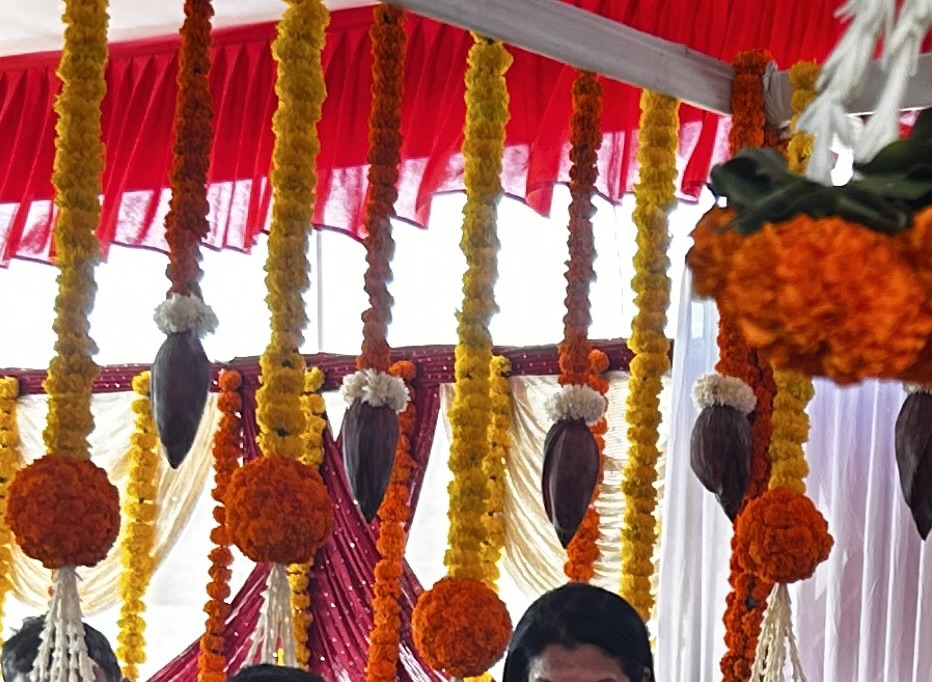
    Over this weekend, three little girls in our family got initiated too! It was a wonderful occasion for the whole family to meet each other with all the trappings of tradition.

    After invoking the blessings of Lord Ganesh, the day before, the actual ceremony began with a special ‘Matru Bhojan’ or meal where the child sits on his/her mother’s lap for the last time to be fed by her.

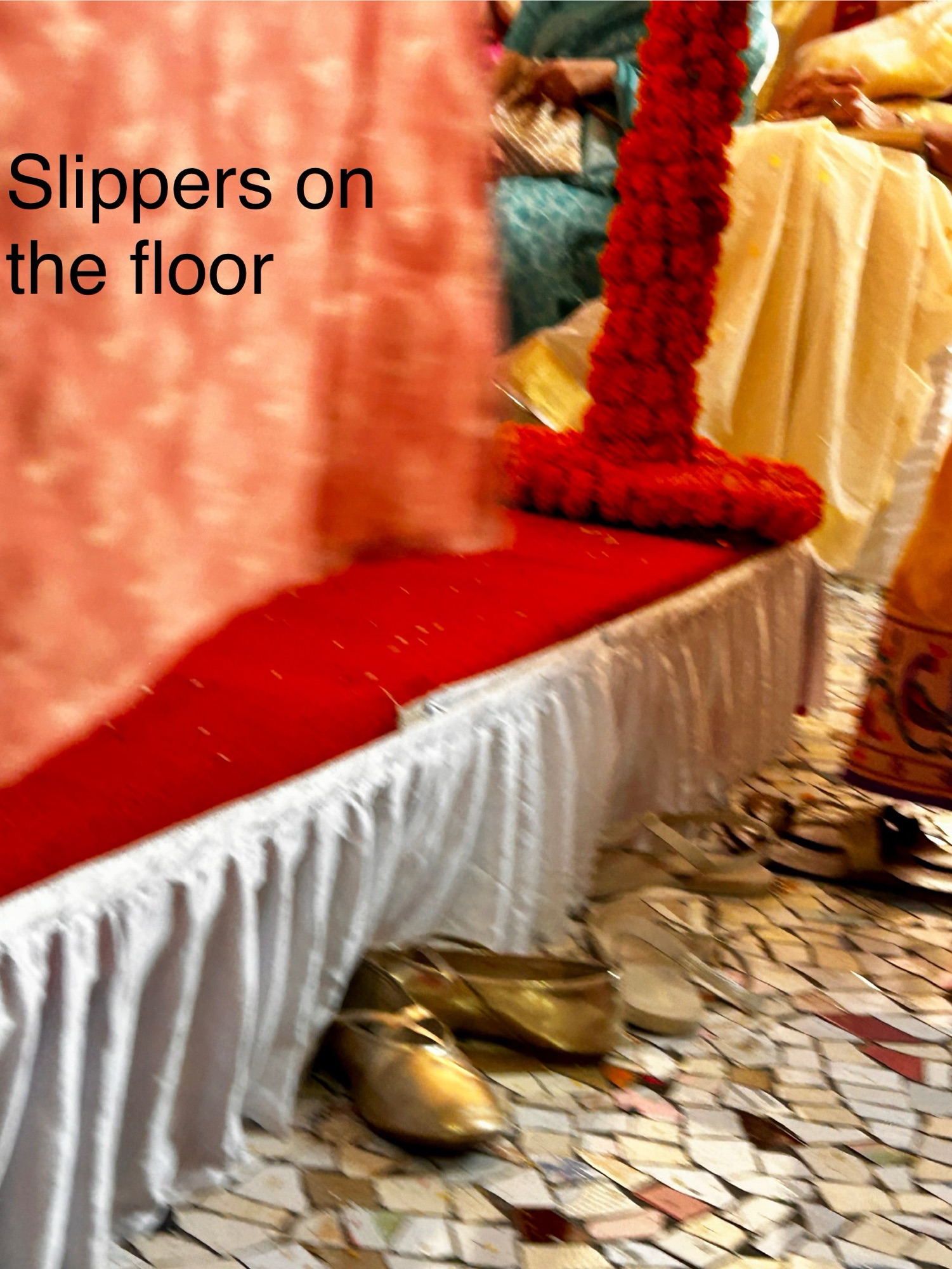
    Then the girls were led to the stage where the ceremonies actually began.

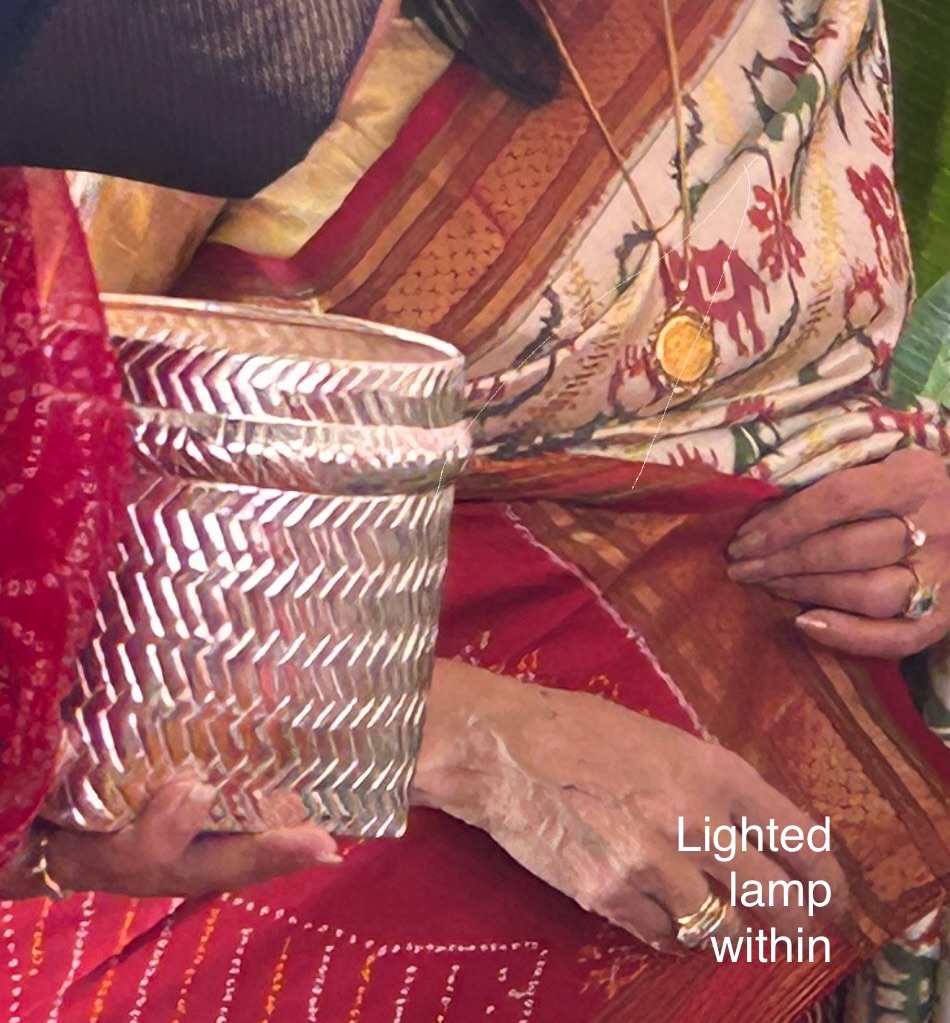
    They were a little bewildered about what was happening as the significance of the ceremony was quite lost on them. However, they gamely sat through in their finery, behind a silk screen held up by two mamas ( maternal uncles)while the priests changed prayers and mantras essential to the ceremony.

    The guests enjoyed mingling amidst the chanting, interrupting their conversation only to shower the girls with grains of rice at appropriate times. On the other side of the screen were the fathers of the girls waiting to garland the girls at the end of the ceremony when the screen was pulled away.

    And then came the best part: receiving the blessings of the elders in the form of cash gifts or big presents, and the big feast that followed.

    Hope your weekend was as fun!

    Ciao

Create your own website, free on WordPress.com.Create your own website.
Start free