Our Mumbai winter which is getting rarer and rarer is really the best time to be in the city . Despite the horrid traffic that increases tenfold and the subsequent pollution I like our Mumbai winters because of the fresh fruit and vegetables in the market .
Kohlrabi or knolkohl is one of the rare gems that Winter gifts us Mumbaikars. Not many people know that this turnip like vegetable is packed with a punch . I like to cook it with another winter treasure – fresh green channa or green chickpeas. This plant is particularly grown in winter to replenish the soil with Nitrogen.
Unfortunately, these little peas are tedious to shell so today I made my favourite winter special with green peas . These too are in abundance and are specially sweet and juicy.
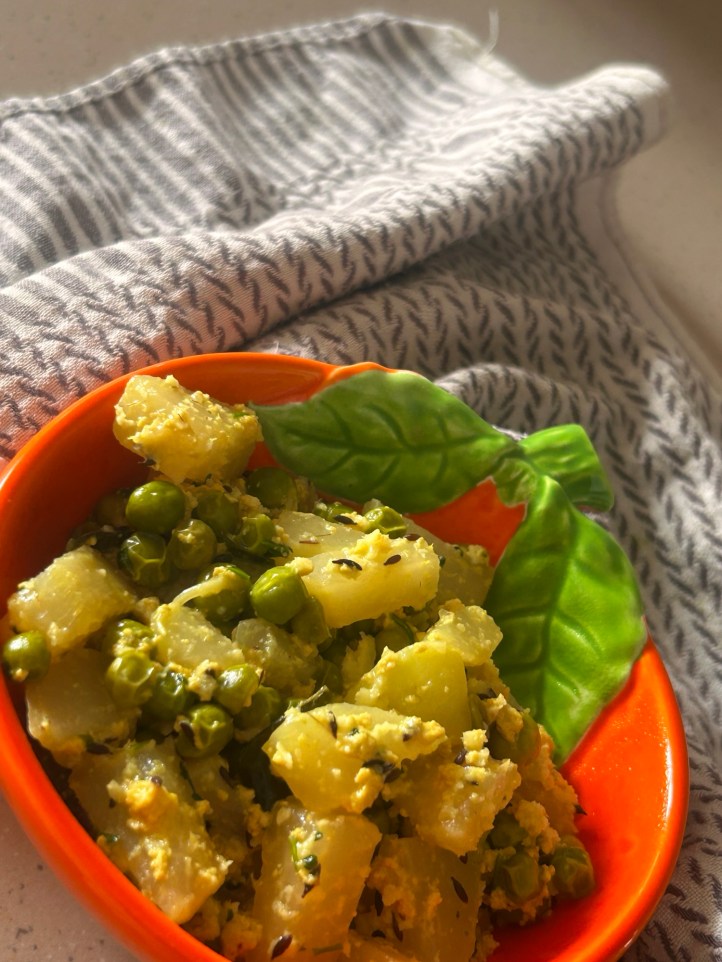
Green peas and kobl rabi
To make this I used
1 small kohl rabi
1 cup shelled green peas
1 tspn ghee
4 curry leaves
1/4 tspn turmeric powder
2 tbspn fresh grated coconut
1 tbspn finely chopped coriander
What to do:
Peel the kohl rabi and cut into small oblong
pieces. Keep in water to avoid discolouration.
Heat the ghee in a flat bottomed pan.
Add the jeera and allow to sputter.
Lower the heat and add curry leaves, turmeric and hing.
Add in the peas and kohl rabi and stir before adding milk.
Cover with a lid. Lower the heat and let cook till the vegetables are soft.
Add coconut and coriander and serve with hot Chapati.
It’s funny how a simple cotton thread can have such great significance in one’s life.
The sacred thread or janeu consists of three strands of pure cotton worn cross-body by upper-caste Hindu men.
I still remember Mrs. Subramanian asking her bare-chested IIT-ian son who was home for the holidays where his sacred thread was when he wandered into the drawing room. He nonchalantly told her that there was no room to pack it in! I could see how difficult it was for her to hold back from giving him one ‘tight slap’ for his cheeky reply.
Once upon a time, all upper-caste Hindu men were identified by the sacred thread conferred to them in a very special ceremony. While many boys still undergo this initiation, not many wear the thread, more so the educated ones, particularly the ‘men of science’ who eschew tradition.
a rite of passage
However, I feel there is something magical about a rite of passage. Every society has a special ceremony marking certain milestones in a person’s life, from birth to death. While these are mainly cultural celebrations, they have religious overtones making them more significant than a plain old party.
Over this weekend, I attended one such function that was primarily meant only for high-caste Hindu boys particularly, among the Brahmins, who were called ‘twice-born’ after they earned the right to wear the sacred thread.
The Upanayan also signified the commencement of a boy’s formal education. He left home to study with his guru in a gurukul, much like today’s children who go off to boarding school. It also compelled him to lead a life of discipline and celibacy. Before his marriage, he would undergo another ceremony where he got another three-stranded thread which enabled him to get on with the next stage of his life.
In ancient India, even girls underwent this ceremony (also called Yagnopavit or Upanayan) but somewhere along the way, this tradition was discontinued and practised only by the boys.
Revisiting tradition
However, in the recent past, there have been instances of girls having their thread ceremonies too. Four decades ago, in Bihar, four girls were initiated into this tradition by Vishwanath Singh who set up a school for girls at a time when girls’ education was strictly a no-no. He wanted his girls to wear the thread because he felt that girls had an equal right to education.
Of, late this custom has gained more currency and a few years ago, one of the girls in our family got her own sacred thread to wear in the Yagnopavit ceremony.
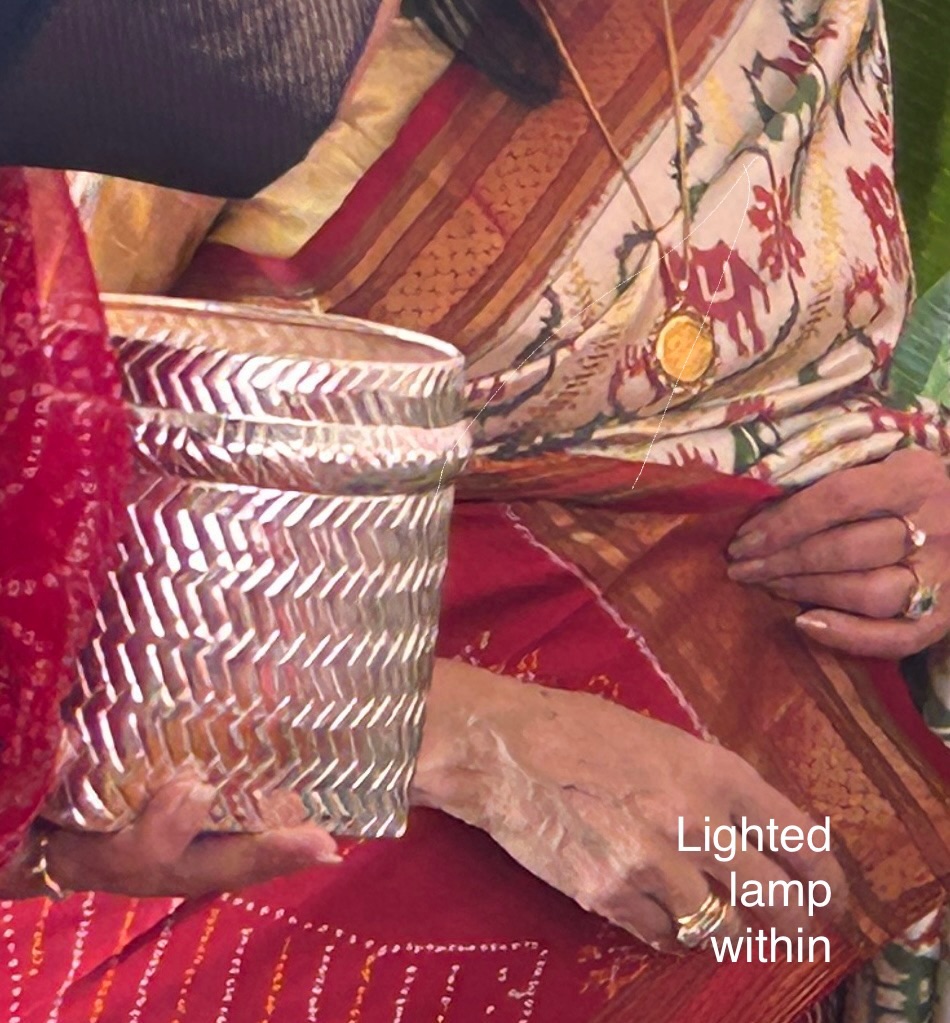
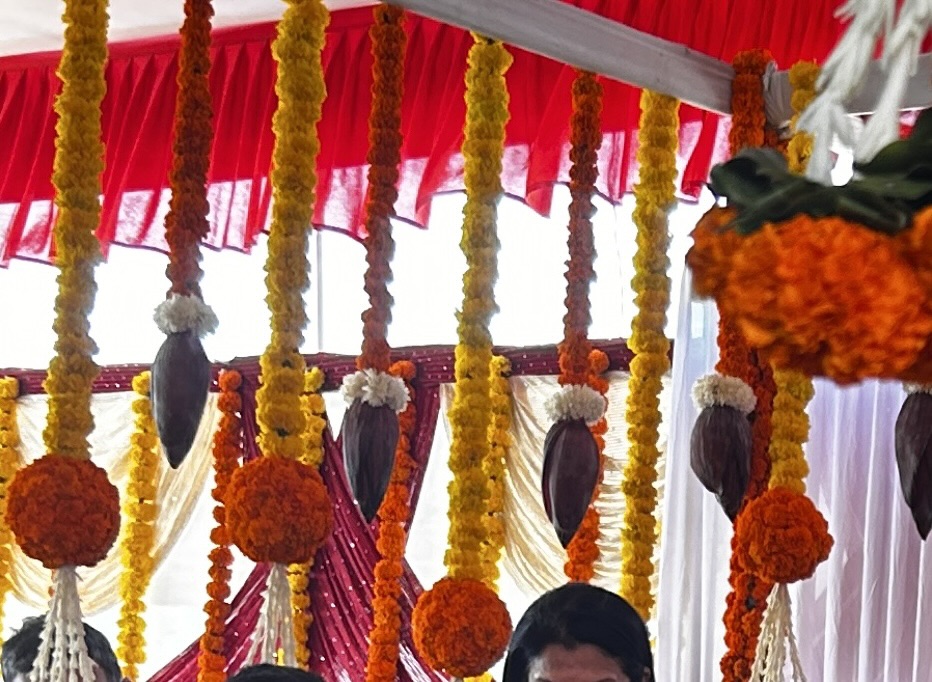
Over this weekend, three little girls in our family got initiated too! It was a wonderful occasion for the whole family to meet each other with all the trappings of tradition.
After invoking the blessings of Lord Ganesh, the day before, the actual ceremony began with a special ‘Matru Bhojan’ or meal where the child sits on his/her mother’s lap for the last time to be fed by her.
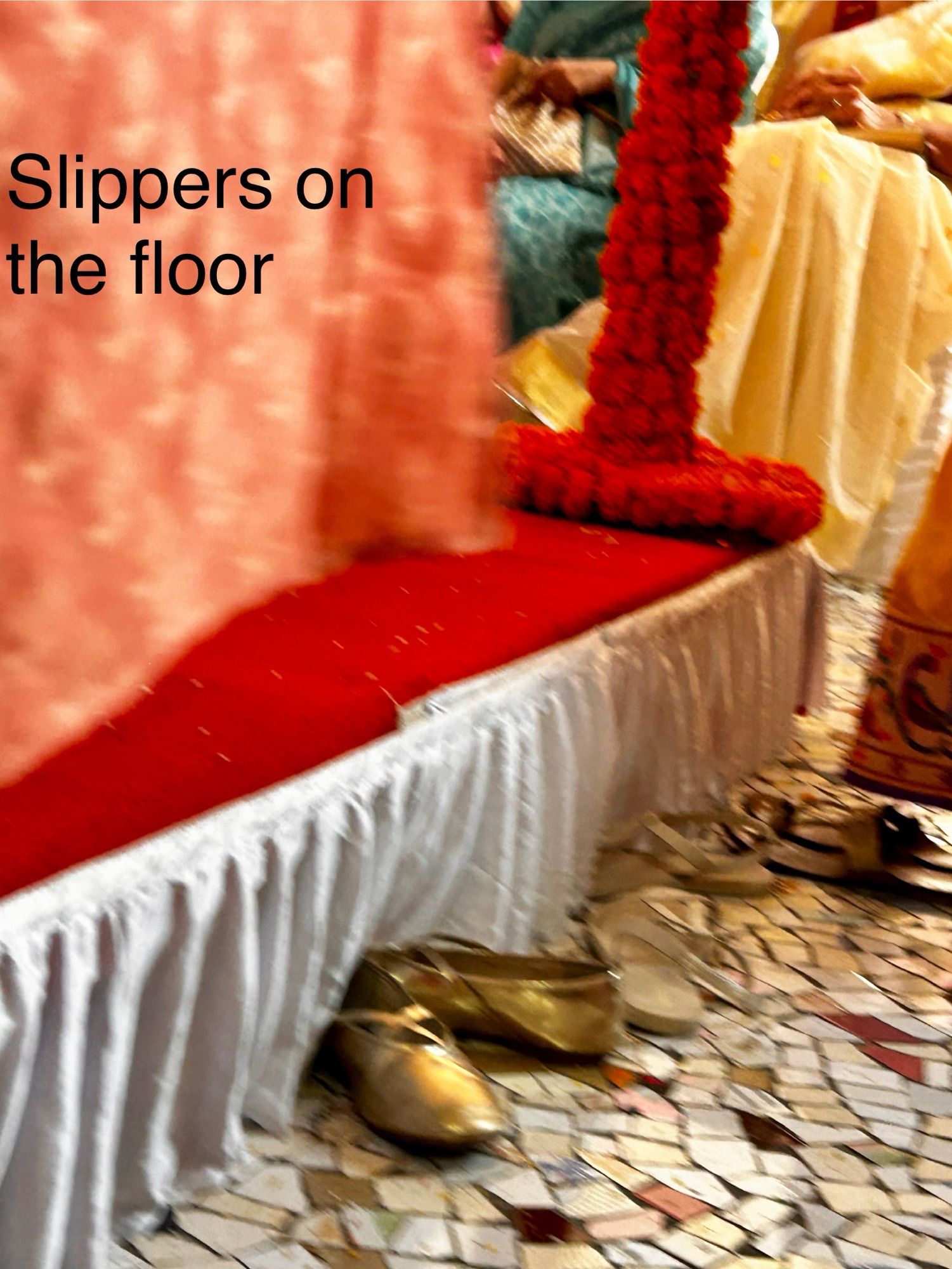
Then the girls were led to the stage where the ceremonies actually began.
They were a little bewildered about what was happening as the significance of the ceremony was quite lost on them. However, they gamely sat through in their finery, behind a silk screen held up by two mamas ( maternal uncles)while the priests changed prayers and mantras essential to the ceremony.
The guests enjoyed mingling amidst the chanting, interrupting their conversation only to shower the girls with grains of rice at appropriate times. On the other side of the screen were the fathers of the girls waiting to garland the girls at the end of the ceremony when the screen was pulled away.
And then came the best part: receiving the blessings of the elders in the form of cash gifts or big presents, and the big feast that followed.
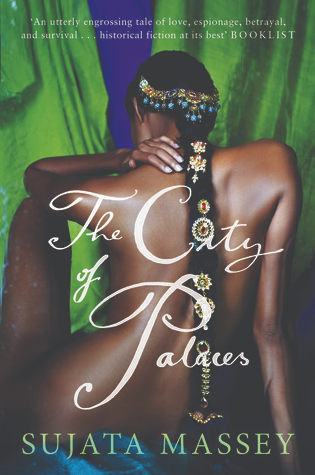
Unlike everybody who greets the new year with a celebration, I greeted it with an all-nighter reading a NOVEL which combines history and romance, my favourite genre these days.
The book’s cover depicting a dusky nude woman may mislead you into thinking the book is about dancing girls and prostitutes in the city of Palaces. Once you get past it, however, you will be captivated by a story that has unexpected twists and turns.
Sujata Massey’s ‘City of Palaces’ is an engaging book which I read from cover to cover in ONE sitting. Something that I hadn’t done for a long while. It was a lovely feeling to stay up way after midnight reading – taking me back to my carefree college days when I could indulge in such luxuries.
Romance in pre-independent India
For fear of spoiling the story, I will not talk about the plot apart from the fact that the heroine or narrator has an almost chameleon-like ability to survive the curve balls thrown at her. While at some level, the storyline is predictable (no I didn’t flip through the pages to find out how it progresses) it holds your interest.
Massey has a delightful turn of phrase and brings to life a romantic, sordid and very real pre-independence India. Her well-developed characters pop out of the pages luring you into their world be it a cyclone, a boarding school or a salon.
Kamala, the protagonist, is strong, gutsy and fearless. Orphaned in a cyclone, she comes across people who sometimes help and sometimes don’t, but with her quick thinking, she gets out of difficult situations. Despite the injustice meted out to her she doesn’t let bitterness and resentment colour her response and carries on stoically.
So if you are looking for an interesting read this weekend, go for ‘City of Palaces’ and find out if Kamala’s story has a happy ending.