Once upon a time when Mumbai was Bombay, the city truly had an eclectic mix of people. It was a city that rose from the swamps, the paddy fields and the seven islands that gradually became one big land mass that spread into the mainland and became the Mumbai of today.
It began with settlements and villages and grew into neighbourhoods and suburbs and finally into one great big metropolitan area.
People came from all over to make their fortunes . From far off places in India and overseas like Iraq and China. The Chinese who came to Bombay in the 18th and 19th century were largely sailors, traders and merchants. Some even came to work in the docks. A large number migrated from Calcutta. And most of them lived in Mazagon.
They worked as dentists, hair dressers, shoe makers, tailors and skilled craftsmen. They also introduced us to their cuisine which became so popular that in the days of yore, when eating at home, was the norm, eating in a Chinese restaurant became synonymous with celebrations.
Chinese food in India became a genre of its own and so entrenched in our collective memories that even overseas Indians seek restaurants serving Indian-Chinese food!
Luckily, though most of this once thriving community has dwindled to a few families, the chinese restaurants still remain. As do a few chinese parlors and the solitary Chinese Temple.
THE TEMPLE OF KWAN KUNG
Thanks to my tour guide, I managed to see this last vestige of a once thriving Chinese community in Mumbai.
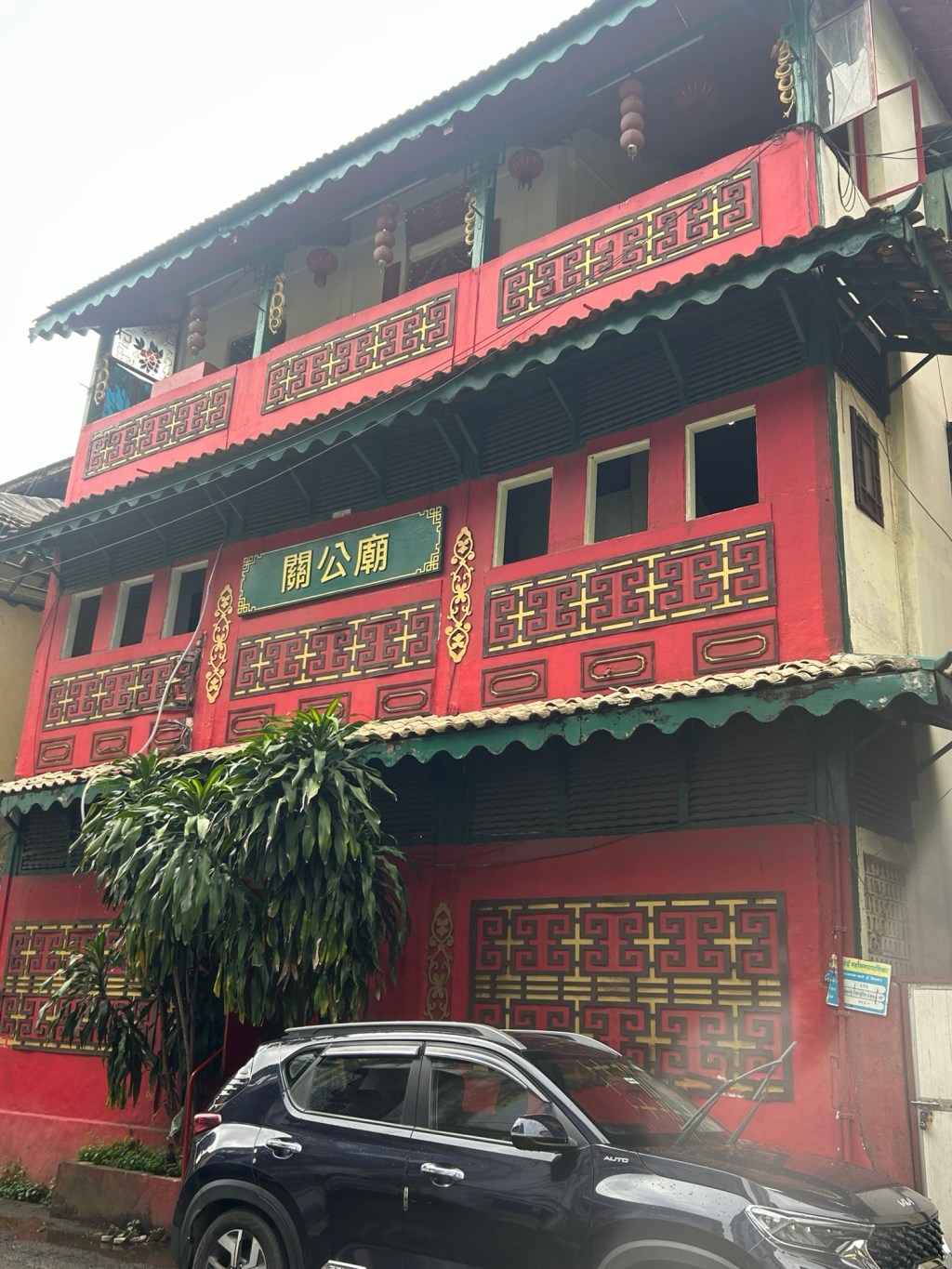
In a quiet street near the dockyard is a red three storey structure looking distinctly Chinese and quite incongruous in a Mumbai street. The Chinese temple is well kept and radiates a sense of calm.
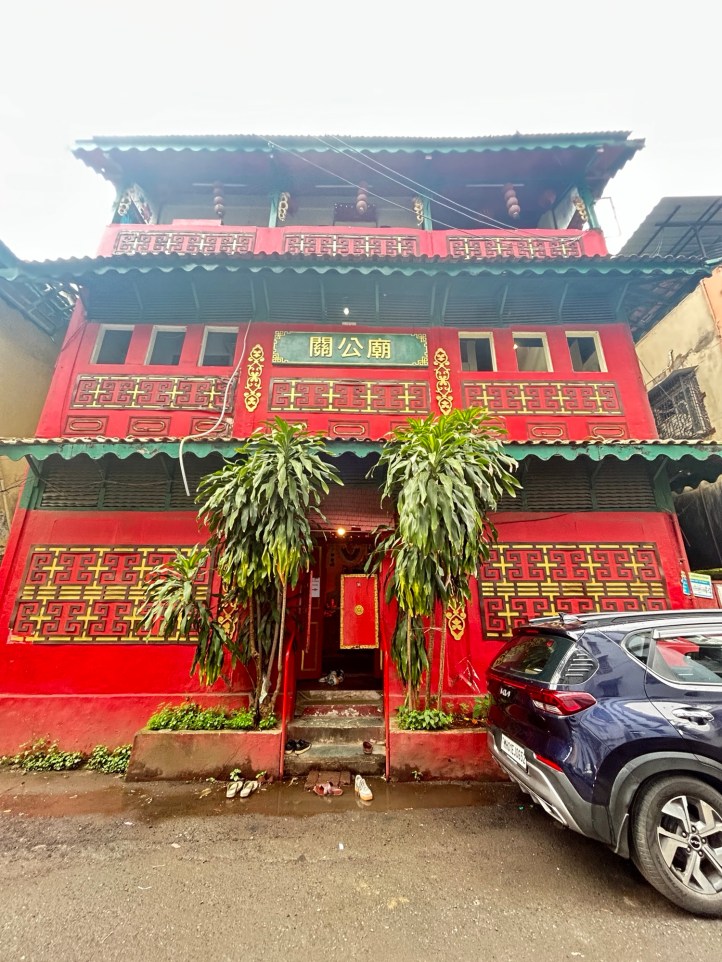
Making our way through the red batwing doors we found ourselves facing a dimly lit shrine of Guan Yin, Chinese goddess of Mercy. From the few slippers left outside, we could make out that there were just a few of us visitng.
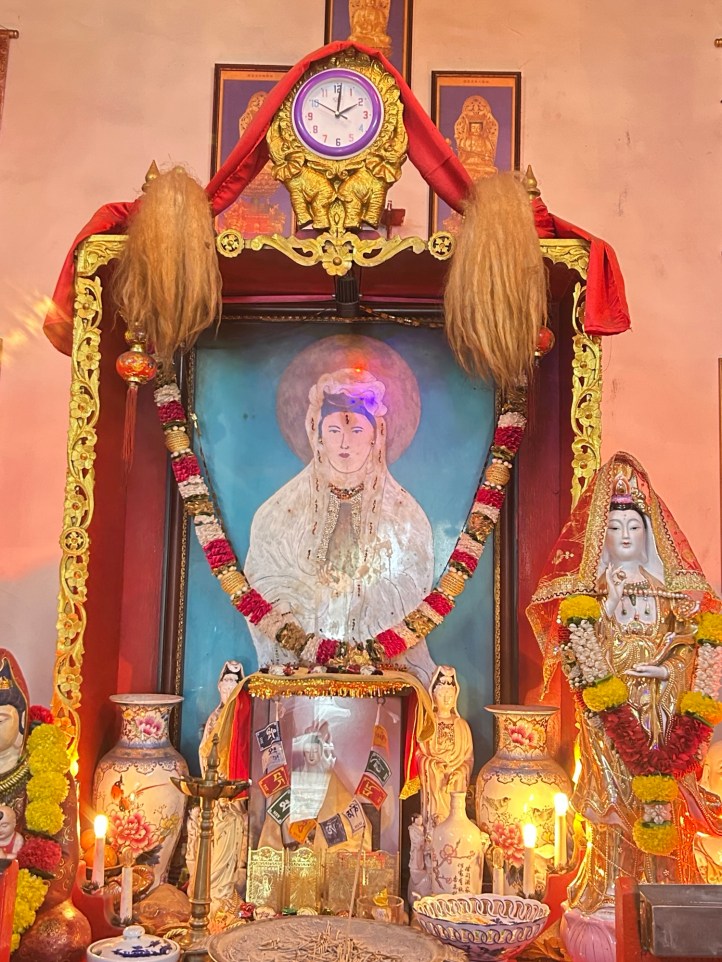
Unfortunately, there was no one around to ask so we had to figure out things for ourelves. From what we could make out, a large painting of the goddess flanked by two other garlanded figurines dominated the shrine. I assume the larger figurine of a beautiful woman was Miso Shar, a princess in her early life, before she became the goddess.
In front of the main painting was a smaller picture garlanded with prayer flags, some figurines, tall vases and some lit lamps.
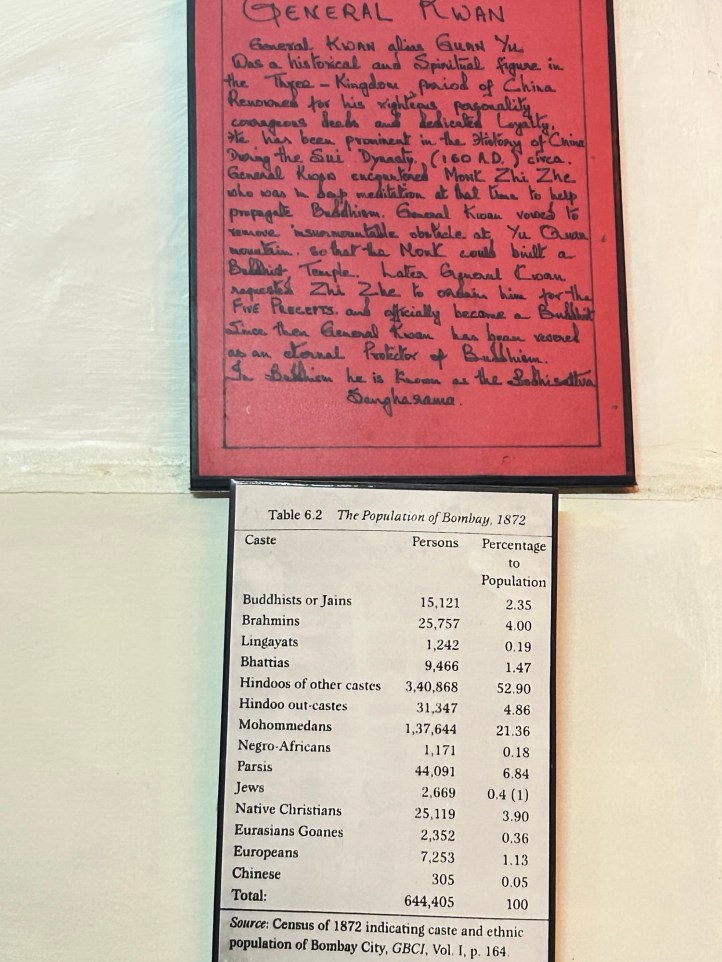
On one wall was the history of General Kwan and a notice of the population of the city in 1872!
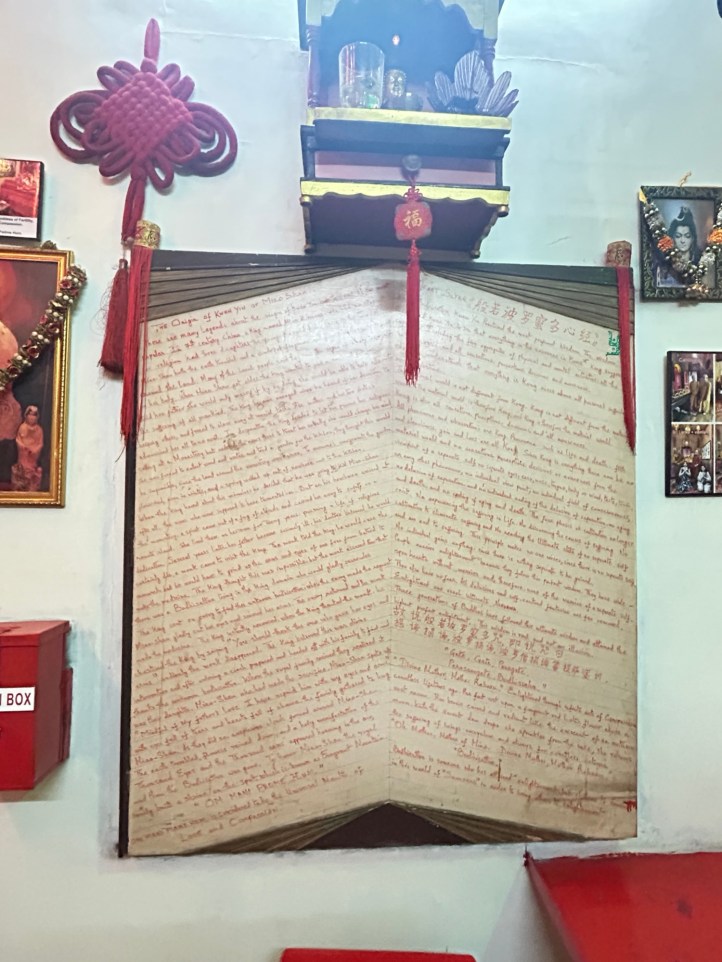
Following a sign, pointing to the main shrine, we went upstairs to see the shrine of Kwan Kung, the warrior God.
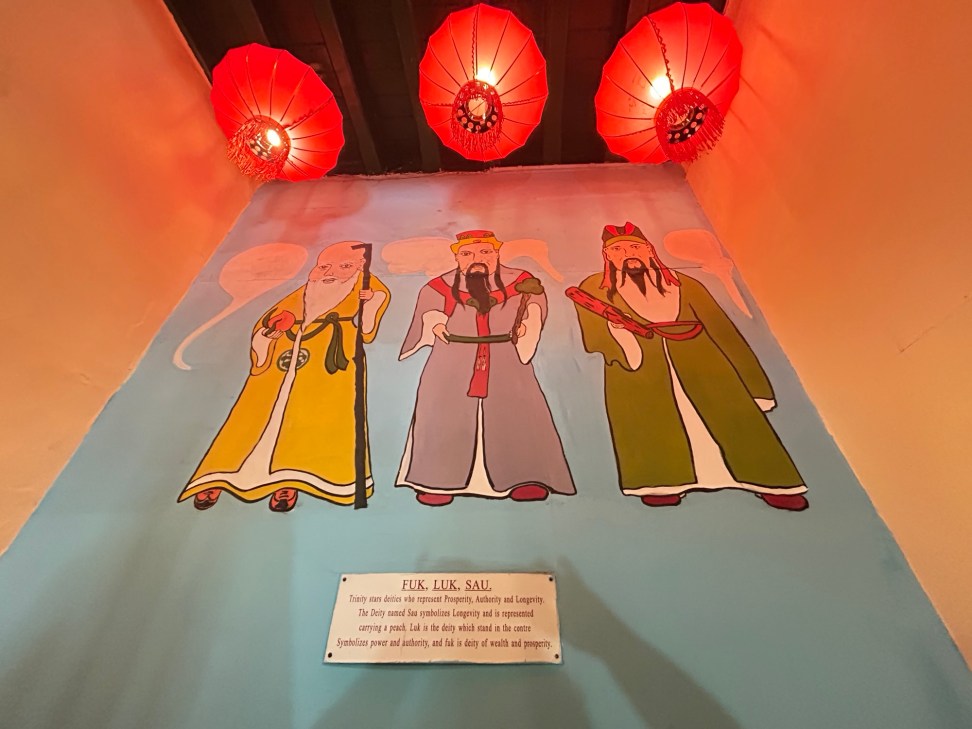
On the landing of the first floor we saw a mural depicting the three gods FUK ( Good fortune) LUK( Prosperity), SAU ( Longevity).
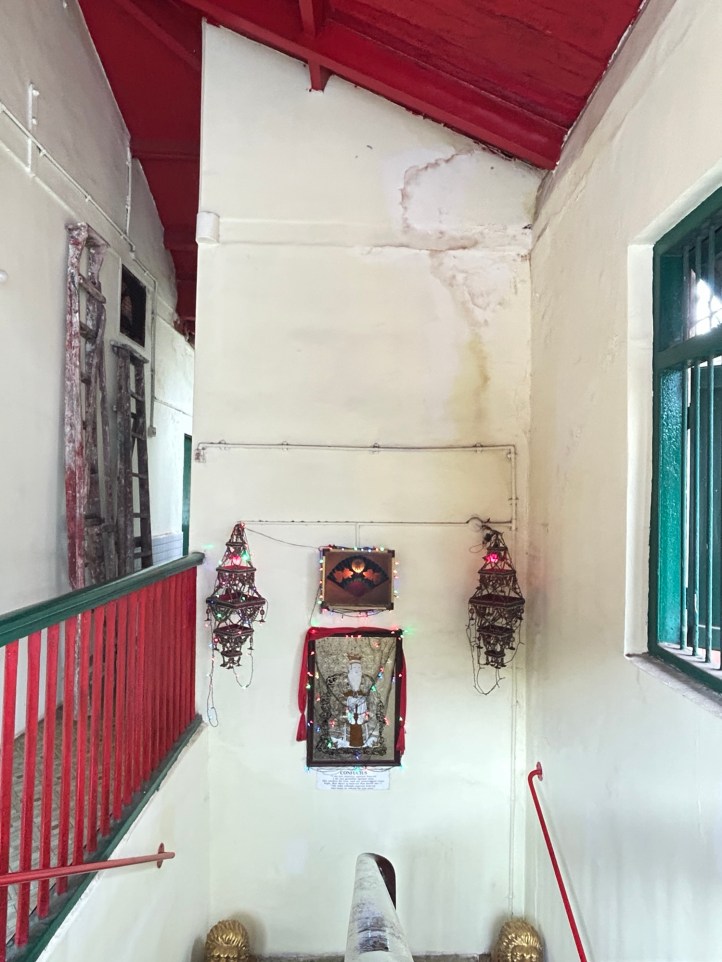
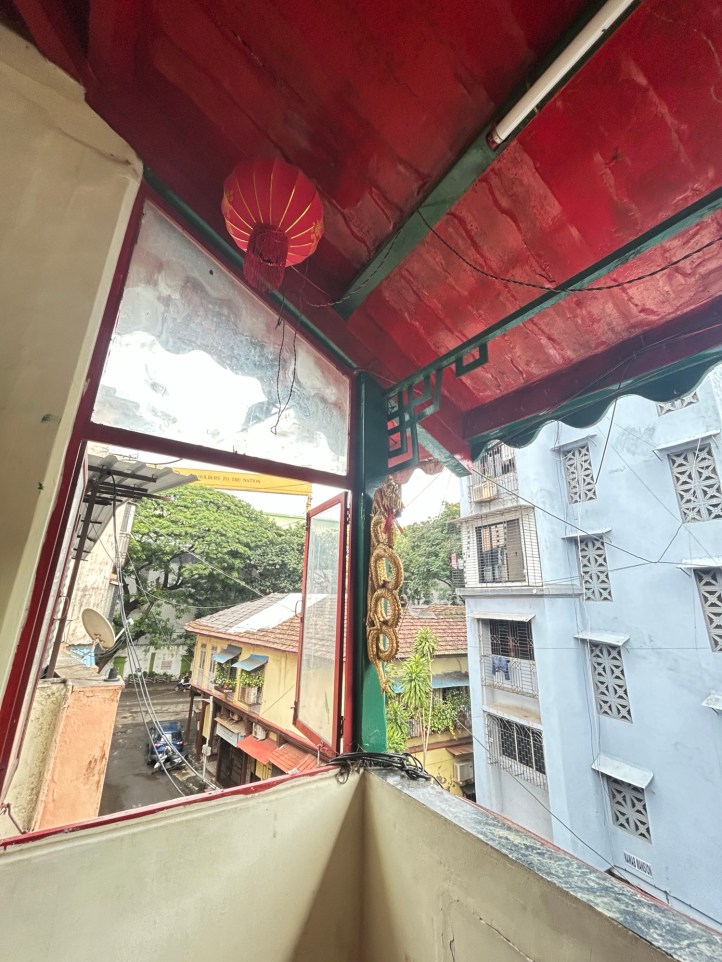
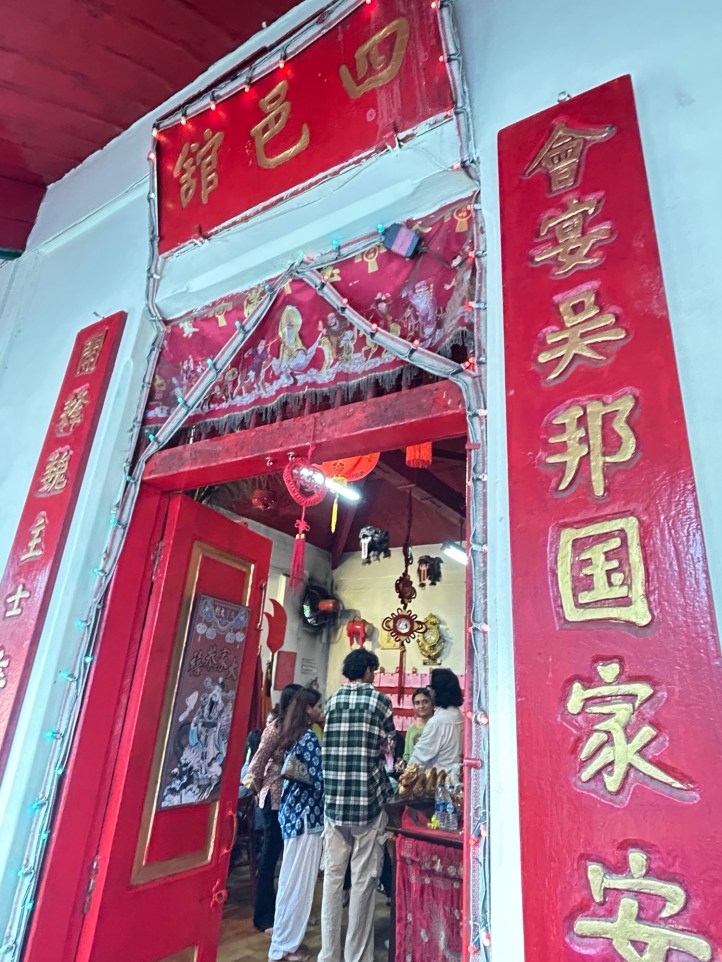
Compared to the deserted ground floor, the second floor was a hive of activity. There were a bunch of people before us. Some were offering prayers and some seated in front of a fortune teller.
None of the visitors were Chinese.
A PRAYER AND A FORTUNE READING
People don’t visit the temple to pray, but also to find out if their prayers will be answered.
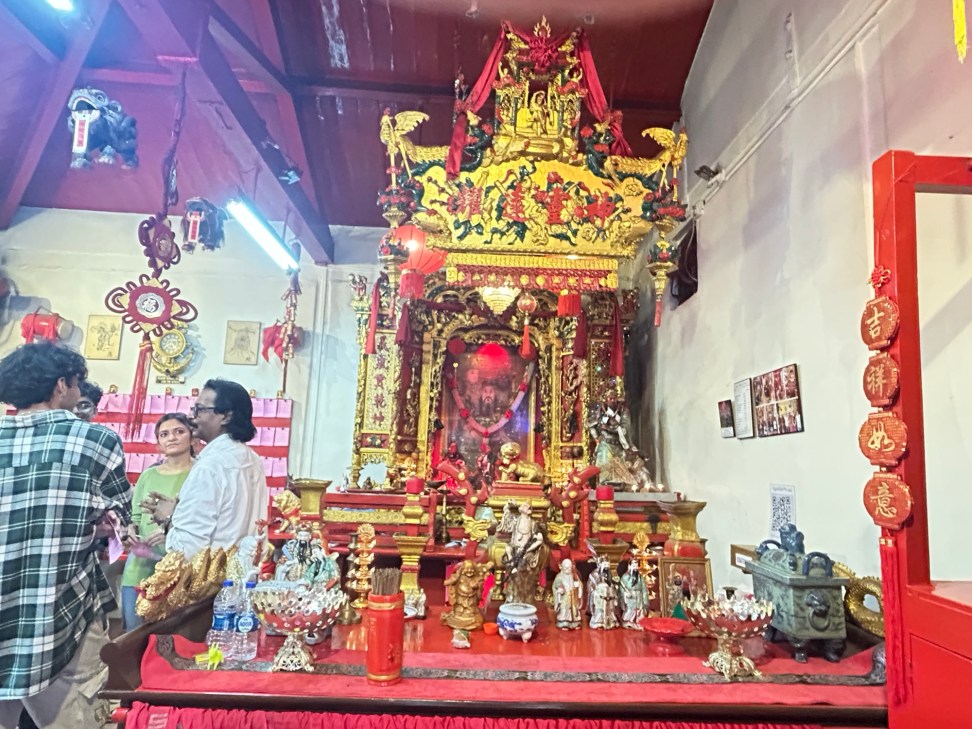
I wasn’t particularly interested in praying or finding out my future, but decided to give it a try. I approached one of the Chinese ladies at the temple who told me to offer some money to the God before giving me two candles, five incence sticks and two bits of paper representing money.
After lighting the candles, I lit the incence sticks, rotated them three times and simultaneously made three wishes. I placed three sticks before the painting on the main altar, one before a figurine below and the fifth in another smaller ‘shrine’ in the verandah. I had to burn the bits of paper placing the embers in a tub .
FORTUNE Telling.
Then, I was directed to the minor altar at the entrance. and ring the bell three times and gong the gong three times. Kneeling on one of the cushions on the floor, i had to recall my main prayer and bow three times. After this, I was given a shaker filled with bamboo sticks. I had to gently shake the sticks till one fell out. Each of these sticks is numbered and I to find the corresponding chit from the chits pinned on the Wall of Fortune.
Though the fortune is written in English, it was cryptic and difficult to make out so I asked one of the Chinese ladies to interpret it for me.
I was a bit disappointed because I don’t think the reading applied to me.
And so we left the Chinese temple.
Ciao,

Disclaimer: I cannot vouch for the authenticity of this information as there were no references I could cross check with.
Just visit it with with an open mind and experience a little bit of China in Mumbai.


Leave a Reply