
• Ratnagiri here we come

    Ratnagiri here we come

    There is a long coast line along the west of India – starting from Gujarat, and going down Maharashtra, Goa, Karnataka all the way to Kerala.

    This narrow strip of land suqshed between the Sabyadri mountains and the Arabian Sea is lush green for most parts of the year with rain pelting down in the monsoon months. Nothing much grows there apart from mango, coconut, cashew nut and rice. There are some other indigenous plants too like Kokum (garcinia indica), jackfruit and banana. But by and large the mountains and the sea made it inaccessible for years, leaving it isolated and underdeveloped for years. It was no wonder that people migrated to seek their fortunes elsewhere.

    But ever since my mum came back from her trip to the West Coast, she couldn’t stop raving about how fabulous her holiday was. As far as I knew, she had just spent a weekend at a homestay in Harnai Beach and had enjoyed the seafood and the company of a couple of friends but came back as ecstatic and fascinated as though she’d returned from the West Coast of America!

    I had to find out for myself.

    So now, after half a day at Alibag, it was time to move south towards Ratnagiri, the land of my ancestors.

    Look before you book

    I didn’t have much time to do any research on Ratnagiri. All that I knew was that my ancestors came from the area. My parents had once visited our ancestral village and I was fascinated to know that there is a place on this earth where everyone ( or almost everyone ) shared my surname!

    But I wasn’t really going in search of my ancestral village. I just wanted to spend a few days away from the hustle and bustle of Mumbai, relax and enjoy the cool breezes of the West Coast. We weren’t looking for a place on the beach. Nor were we looking for a fancy hotel. All we were looking for was a decent homestay .

    Sadly, the homestay options offered by the travel agent didn’t quite make the mark so we were booked in the Dio Reggalo Theme resort which was perched on a hill 17 Km away from the city. Not only was this hotel inconveniently located, it was very poorly managed.

    With no signage to guide us, and no lights to see where we were going, we completely missed the Reception. And when we went back to it, the ‘manager’ started spraying some mosquito repellent and told us not to come inside. But since he was expecting us, he sent the bell boy to show us our room.

    We were allotted a room in a cottage on the top row. This was highly inconvenient and dangerous for two old ladies to go traipsing around slippery slopes in the dark. The room didn’t have a single plug point that worked and such poor lighting that we had to use our phone torches to find the plugs and switches. When we asked for a change of room, the bell boy was shocked that we wanted to move because this room had a television that worked!

    The staff was poorly trained and had no idea of what hospitality meant. The restaurant had an exhaustive menu but half the items weren’t available.

    The Palace of A Burmese King

    The disappointment of the choice of hotel didn’t dampen our enthusiasm to visit the city. After all, we hadn’t really come to Ratnagiri to sit around and have chai in the verandah. We just wanted a spot from where we would visit other places nearby.

    The sky was still overcast and threatened to rain so after a quick breakfast, we made our way to the city to see one of its main attractions – the Palace of Thibaw, the last king of Burma.

    At first glance, the building looks impressive but must have been a real comediwn for King Thibaw who lived here under house arrest for the last six years of his life. De-throned and deposed, the last king of Burma was sent to far off Ratnagiri, with his second wife who was pregnant at the time, a place so isolated and desolate that he would truly be lost to his people and the world. Deposed in 1885, the royal family lived for 24 years in another house till the Palace was completed in 1910,

    Sadly, he lived there a broken man till his death in 1916. Thereafter his family moved back to Burma leaving behind a daughter ( Tu Tu) who had married a local palace retainer. Till today her descendants live in Ratnagiri in relative poverty quite unmindful of their royal lineage.

    After the royal family left the building, it was used as a government office for a while and then as a Polytechnic till its present avatar as a museum.

    Recently, the government has made some efforts to refurbish the building and the roof has been re-tiled and some of the original Burma teak wood doors replaced.

    The interior, however, is a real let down. An old caretaker makes you sign a book and pay a fee of Rs. 30. There is no one to take you around and the caretaker warned us not wander off as much of the edifice is crumbling and areas are cordoned off. There are some rooms on the first floor that have sculptures that were found in the area but of no relevance to the King. Another room has a portrait of the solemn looking king, and a carved chair but is totally inaccessible for a close look.

    But the Government seems to be serious about restoring the palace from the Sound and Light show slated to be held after the monsoon. In front of the mansion you can find lights and benches waiting patiently for the show to begin.

    It will be quite awhile before the building is restored to its orignal form and till then, a visitor will be welcomed and shown around by a few enthusiastic stray dogs and a desultory watchman.

    The Royal Tombs

    We visited the tombs where he and his wife are buried but once again, the complex had neglect written all over it. In 2016, a hundred years after King Thibaw’s death, his descendants from Burma were allowed to visit the tombs to pay their respects. At that time there was a cursory spruce up but soon enough they were left to descend into ruin.

    Isn’t it a pity that the King of Burma, head of one of the richest provinces of the British Empire lies in a badly maintained tomb , un-marked, ignored and neglected in the middle of the city, amidst crumbling apartment blocks?

    The tombs were inaccessible with tall grasses and weeds growing all around. We did manage to enter one compound but were scared to venture close because of the mossy tiled brickwork that may have had us slip and fall!

    The inscription

    Birthplace of a freedom fighter

    While the King of Burma was exiled to Ratnagiri, one of Ratnagiri’s famous sons was imprisoned in Mandalay ( Burma). Was it by coincidence or design?

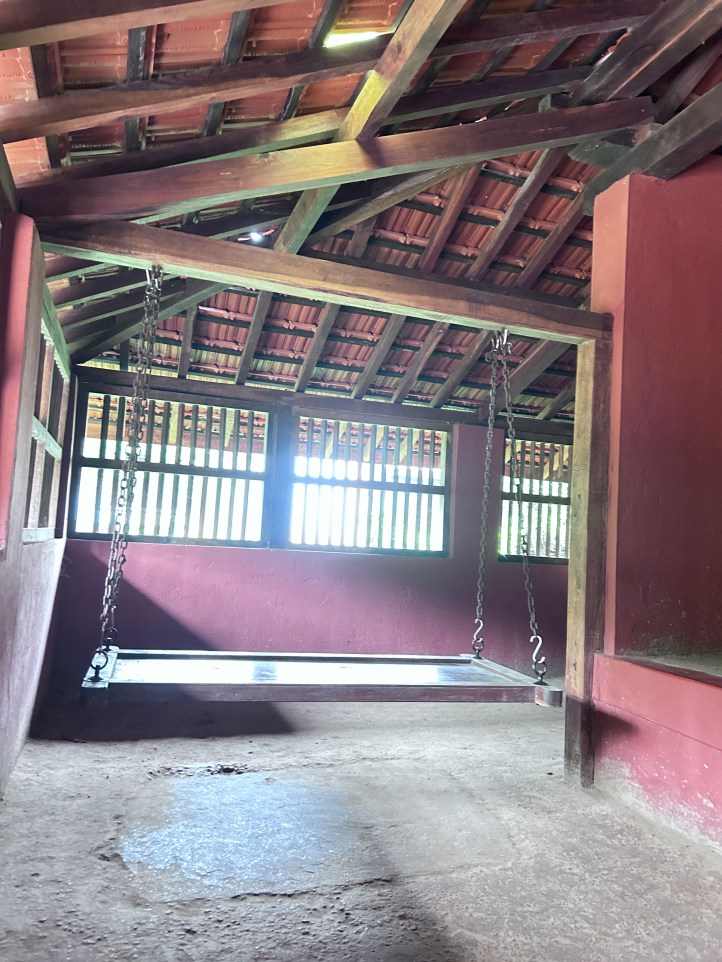
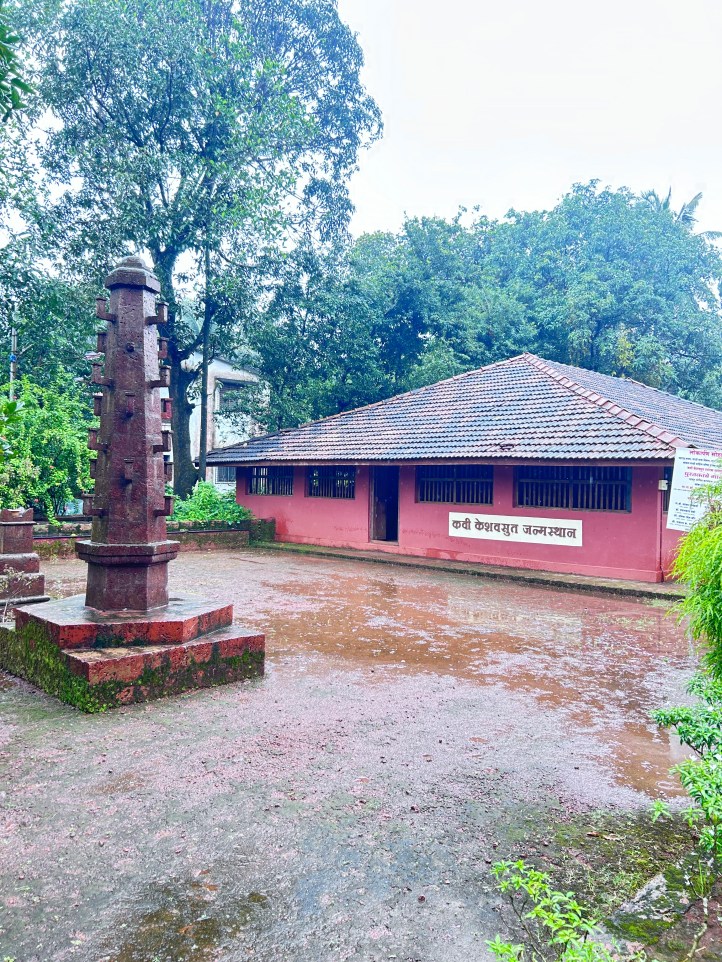
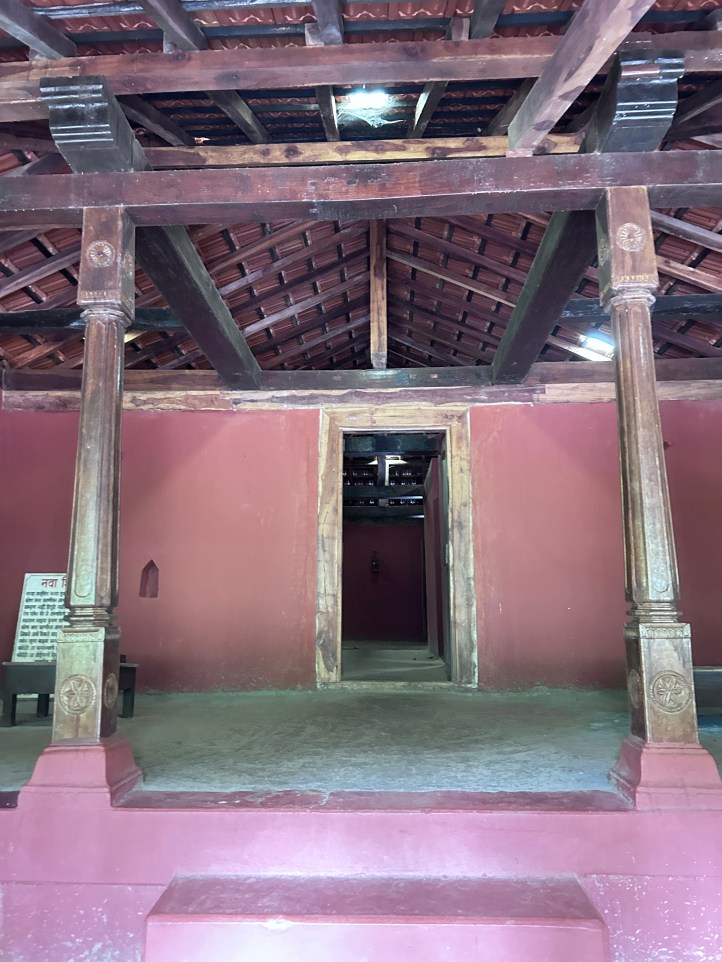
    Keshav Gangadhar Tilak known as BAL Gangadhar Tilak was born in a modest house that is restored to its pristine glory.

    Well maintained and well kept it is memorial that showcases his life and involvement with the freedom movement.

    The house opposite which is still in use remains a good example of Konkan architecture in the late 19th century.

    I wish that both Thibaw’s Palace and Tilak’s house were recreated to show how they actually lived in those times. If nothing else, a well informed guide would have added value to a tourist’s visit.

    Konkan Angan

    It was time for lunch and taking a tip from Trip Advisor, we selected the #3 restaurant on their list since that seemed to be the only restaurant offering local cuisine. We drove on the highway towards our hotel and almost missed the restaurant.

    It looked so different from the photos on Trip advisor which showed a decent but simple eatery with outdoor seating.

    What we got instead was a non descript set of three garages in a building still under construction. . One garage and was for the general public and had plastic chairs and metal tables. The other garage to which we were invited had one table covered with a gaudy rexine table cloth and plastic chairs.

    I was a bit apprehensive but Mrs B was quite confident that such a simple place would serve authentic homemade food that was tasty and fresh.

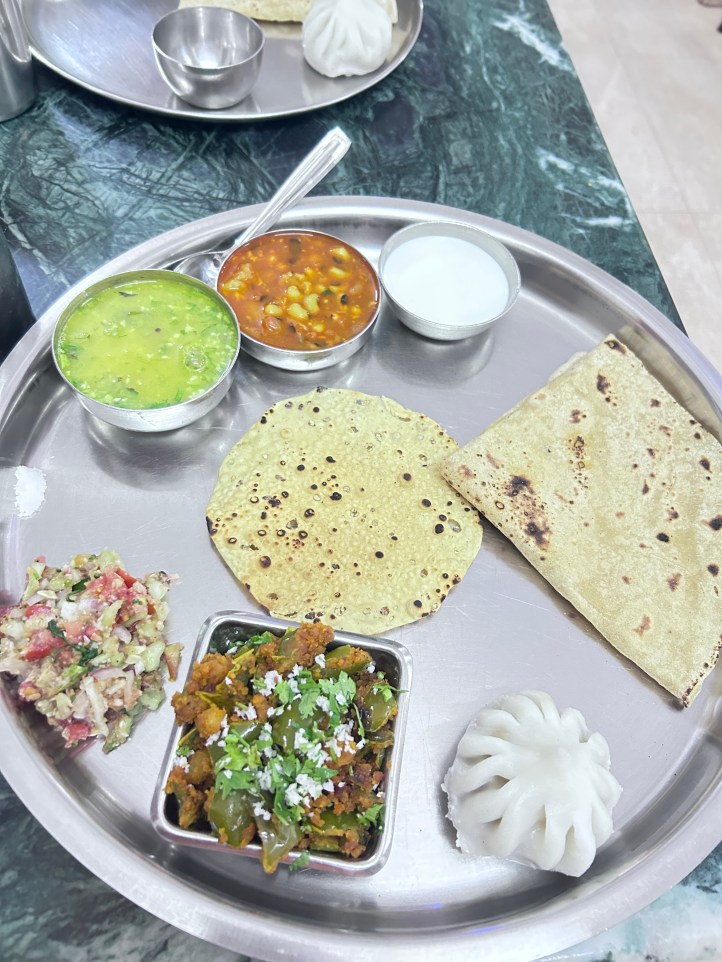
    She was right as always and she enjoyed her crab curry and rice flour bhakri while I relished my freshly fried, freshly caught surmai slice with bhakri. We washed down this meal with a glass of the creamiest sole kadhi.

    The rexine covered table cloth.

    It was definitely a meal worth having and when we saw the number of people coming for takeaways and eating next door, we realised that TripAdvisor knew what they were talking about.

    By this time the rain had started so we returned to our room on the hill.

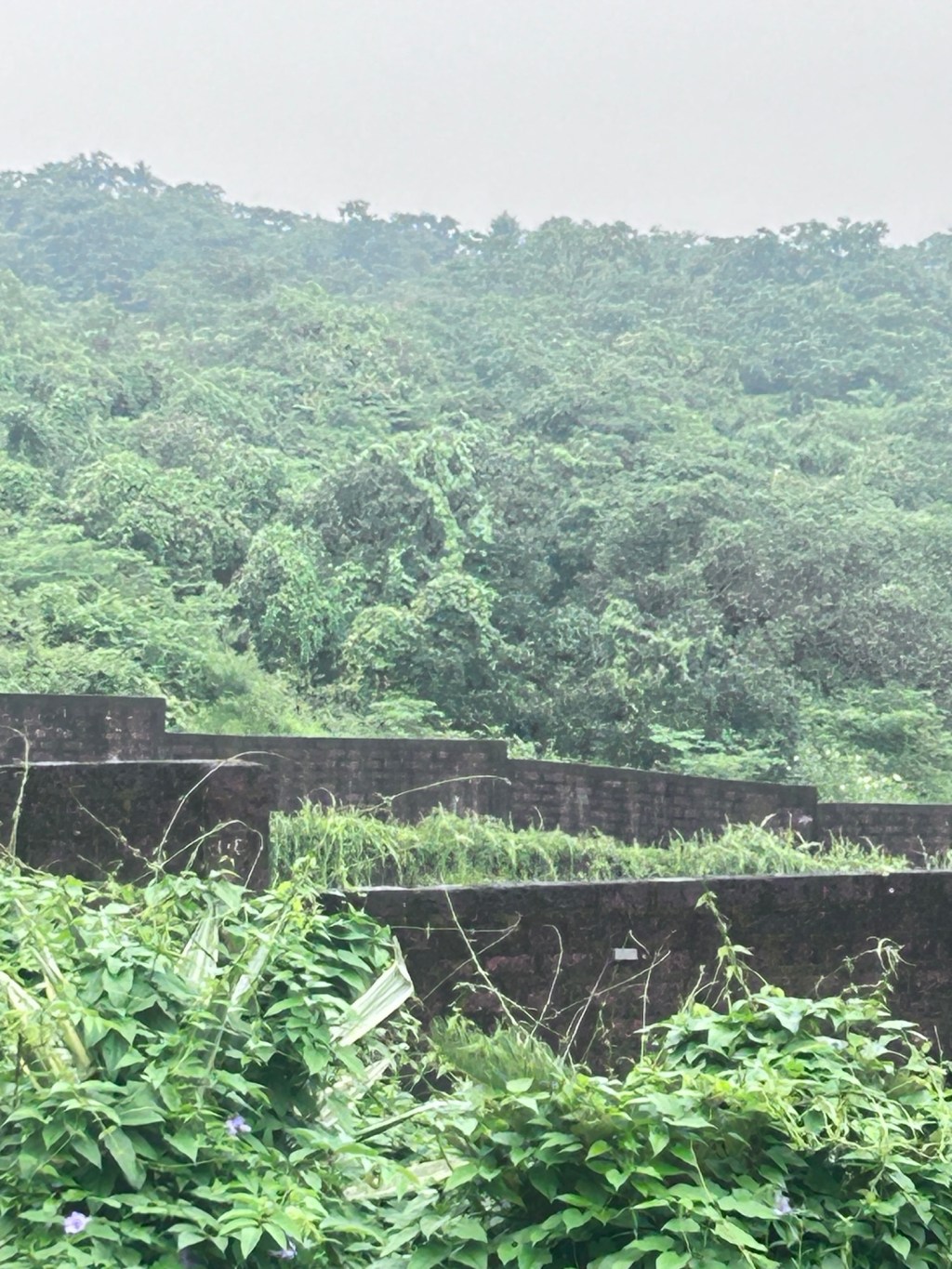
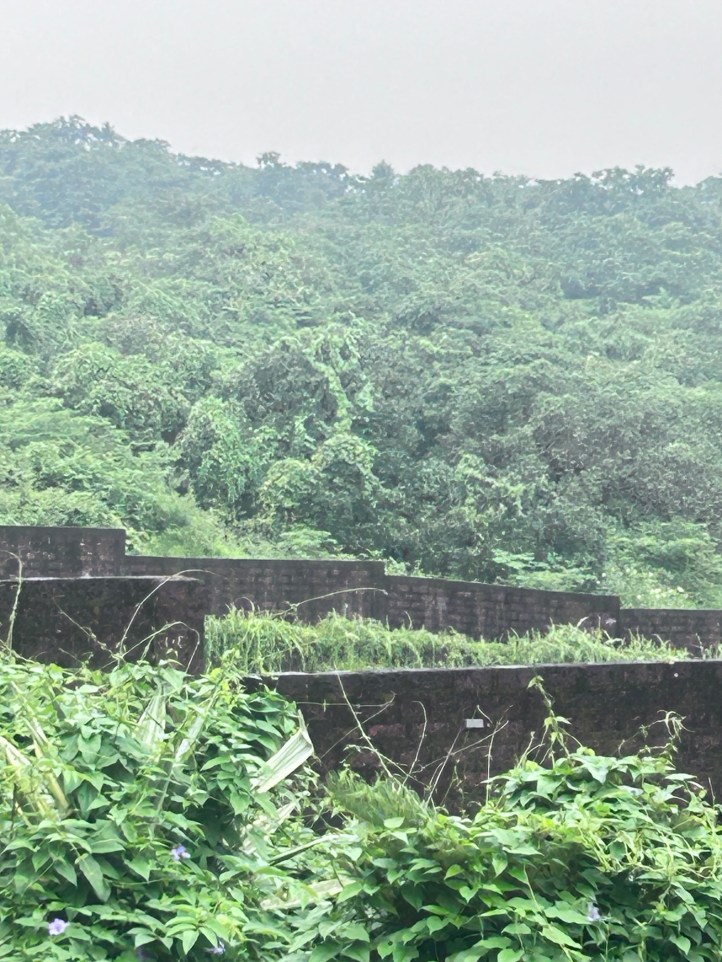
    By evening the clouds had descended on us. All around us was lush green foliage and a peaceful calm.

    I began to understand why my mum was ecstatic about the West Coast.

    Ciao

  • Alibag & the Marathas

    Alibag & the Marathas

    Seeing a place through the eyes of a local is very enriching and informative . As we discovered talking with Yogiraj. Alibag has more than beaches, luxury villas and a few Jewish families. It has a historic past dating from the time of the Rashtrakutas.It was part of Raigad district that came under Rashtrakuta rule.

    A smattering of British Presence

    The islands of Bombay that were handed over to the British as part of the dowry of the Portuguese princess Catherine of Braganza when she married King Charles II, were cunningly shown by Portuguese cartographers as being closer to Brazil which was of more importance to the British. Disappointed at finding out that these malaria-infested islands were in the Orient, the crown handed over the islands to the British East India Company, little realising what a treasure they had parted with!

    In the 17th Century when Alibag was still part of the Maratha Empire, an unarmed British ship foolishly ventured towards the mainland and was captured by the Maratha Navy in nearby Thal creek and its crew imprisoned in Khanderi Fort nearby.

    It wasn’t long before Alibag came under British control and vestiges of colonial architecture can be seen in some buildings like the Forest Department Office which was once the Collector’s bungalow and the Geomagnetic Observatory.

    This important observatory made out of special non-magnetic Porbunder stone, serves as the calibration centre for all those who use magnetic compasses for navigation. It is also part of a global network that measures geomagnetic forces, and its data is shared by scientists worldwide.

    As with most government buildings, entry is prohibited without prior permission so I could just about get a photo from the car.

    The Mission that failed

    On our way to the waterfront, we passed the Konkan Education Society Head Office administrative building, which is important simply because it is built on the site of an impressive colonial stone building that housed the John Elphinstone Scottish Mission. Though the Mission ran a successful school, it failed miserably to convert the locals. So, the Scottish missionaries had to pull out and hand the school over to the locals to run.

    Maratha Navy

    It was past noon and the sky was still overcast when we reached the waterfront. There before us lay the magnificent-looking fort just off the beach. The tide wasn’t low enough for us to walk across, so we could just see it from afar.

    Alibag fort

    The great Maratha warrior Shivaji realised the importance of a maritime force to protect his kingdom from marauding sea farers like the Siddhis and the Portuguese. Thus began the construction of Kolaba Fort or Alibag Fort as it is known today. He enlisted the help of Ferraro Viegas and his son to design and construct the Fort. With 200 local craftsmen ( or tapasis) the construction began on April 19, 1657.

    It was completed by Sambhaji Maharaj and was the stronghold of the Maratha Navy under admiral Kanhoji Angre.

    An informative post on this fort can be accessed below

    More Alibag

    There are many temples in Alibag and Yogiraj wanted us to see the Ram Mandir temple which was built by Govindsett who was a Dewan of the Angre. A lithograph of this temple was by colonial artist James Forbes can found in his book in ‘Oriental Memoirs’.

    This temple has an inner sanctum sanctorum with marble idols of Ram, Laxman and Sita . There is another inner hall for special pujas and a large hall with balconies for public worship. A set of stairs on either side allowed women and children to sit upstairs while the men congregated below.

    You can find out more about this temple at https://alibagonline.com/places/shree-ram-temple-ramnath

    Unfortunately we didn’t have much time to spend so we had to give the Karmarkar Sculpture Museum a miss. I was a bit disappointed not to see this because my father claimed that the sculpture had made a small door stopper of me as a baby! I wanted to check if this was true of just one of his tall stories!

    Another site which Yogirsj insisted we visit was the Icecream Soda factory on our way out of Alibag. This highly recommended treat is manufactured locally by D. Samson Digodkar. Sadly, the road was under repair and the signage was easy to miss.

    The sky was looking ominous with dark clouds which had already broken into a drizzle. We still had another 6 hours to go so we decided not to turn back to look for the factory.

    I will have to go back to Alibag some time soon to taste the original Icecream soda. factory. I’m sure the Little People would love it.

    Ciao,

  • ELIJAH’s GARDEN Or ALIBAG ?

    Alibag today is home to many Mumbaikars especially the rich and famous who like to hop into their speedboats and head to the mainland for a rejuvenating weekend break. But it wasn’t always so. Not so very long ago, ‘Alibag’ as it is known was a conglomeration of tiny scattered villages of ordinary people doing ordinary things like farming and fishing.

    After a quick breakfast of Pohe and Dossa , Yogiraj took us to see the Ghodyache Taap or a Rock with a hoof print. Legend has it that the Prophet Eliyahu Hannabi came down to see how his people were faring . The hoof print was left as his chariot took flight from the rock which strangely resembles a runway strip.

    Eliyahu Hannabi in his chariot

    On the way to the Rock we passed a Jewish cemetery.

    The rock itself is venerated by the locals and we were told to remove our footwear if we wanted to go closer to the rock. A couple living in a house close by light a lamp every day. But this is of great importance to the local Jewish families who come here to offer thanks with lamps and ‘malida’, a mixture of beaten rice flakes, coconuts, jaggery and dry fruit.

    Till today this rock is venerated even by the locals .

    The Bene Israeli

    On special days the few remaining families come with Malida a mixture of poha, jaggery and offer it in Thanksgiving along with lighted lamps .

    Over 2000 years ago, after the burning of the second temple at Jerusalem, a group of people fled Palestine seeking safer pastures. They were shipwrecked off the west coast of Maharashtra and were washed ashore at Navgaon ( in the vicinity of Alibag).

    The 7 couples were oil pressers in their native Palestine so when they came here they continued this profession that they were familiar with. Hence they were known as Telis or oil pressers and because they observed the Sabbath, were called ‘Shanivar Teli’.

    Initially the oil they produced was bitter and inedible, so was used as a lubricant by the fisherfolk but gradually they pressed edible oil and branched out to other professions. However, the moniker prevailed.

    The Telis adopted the customs and dress of the locals, and were indistinguishable from the locals. Apart from the star of David and the Hand of Mariam on their homes, their observance of Jewish customs and prayers, and their names, they could easily be mistaken for locals. Till today, they speak Marathi, and their food is influenced by the local food thought following strict kosher laws.

    While their names like Elijah, Benjamin and Samson were derived from the old Testamen, their surnames denoted the village of their origin. Thus a Benjamin from Awas became Benjamin Awaskar.

    Locked as they were, far away and isolated from their original homeland, they practiced an Orthodox form of Judaism as it was how they knew it when they left.

    The Husband Boats

    Like most people from Alibag, the Bene Israeli began seeking jobs in Mumbai and other cities inland. They took up jobs in the Military and the government. They were well known in the field of education (particularly their women who were much sought after to promote and spread female education). So, in the early years, like the other men from Alibag, many of them commuted from Mumbai to Alibag, catching the Saturday boat home from Ferry Wharf and returning to work in the city on Monday. Thus, these boats came to be known as Husband Boats since most of the passengers were men who worked in Mumbai from Monday to Saturday.

    But, by the early 18th century some took their families with them and they formed settlements in Bombay. and Thane. It was only when a Cochini Rabbi noticed some women in Byculla fish market buying kosher fish and followed them home, did he realise they were Jewish and brought them into the mainstream.

    Yasmin! Yasmin! & Israel Ali

    The three Jewish homes in Israel Ali

    We were on our way to the synagogue and we passed through Israel Ali ( or alley) as evidenced by the signboard advertising a doctor’s clinic

    Zoom in on the address above

    Suddenly we heard excited shouts of “Yasmin! Yasmin!” from the third house in a row of houses which once belonged to a Jewish family. While two brothers migrated and sold their property only one house remains with the family.

    The lady had mistaken my friend Mrs B for one of the former residents who had come for a visit (as many Bene Israeli still do).

    Magon Aboth Synagogue in Israel Ali

    Going back to the early 1800’s the synagogue as it is seen today was built in 1910.

    The fine wooden shutters and stained glass windows
    The impressive doorway

    Though it is still active, it is closed to the public and one can only visit with prior permission.

    Mrs B, my travel companion, was particularly intrigued by the Bene Israeli having had many friends from the community in her childhood.

    Today most of them have migrated and very few remain. Yogiraj has two families still living in his village and he talks very fondly of his neighbours Benja and Abraham.

    With his deep knowledge of Alibag and its people, he made me aware of many aspects of history that are normally given a miss.

    Did you know, for instance, that the station MASJID on the Harbour Line gets its name from the Shaar Harahamim Synagogue, or Gates of Mercy Synagogue which was the oldest synagogue in Mumbai?

    Watch this space for more on Alibag and beyond.

    Till then

    Ciao

Design a site like this with WordPress.com
Get started