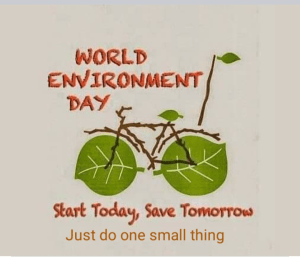
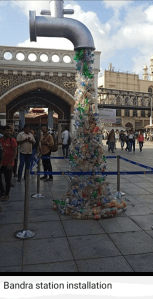
So today, we mark yet another World Environment Day where we talk about saving the world before we become extinct. Once again we have programs organised to make people aware of the environmental damage that we are creating intentionally or otherwise.
Once again there will be WhatsApp messages like the ones I received below beseeching people to save the world before it is too late.
Considering the fact that this movement has been active since 1972, and the climate is still changing, and the earth is still warming, and the fish are still dying in oceans where plastic is indiscriminately being dumped, I seriously feel that this is another drum beating exercise in futility.
Don’t use Plastic – Mix up the beans
When we go shopping for simple household items like vegetables, the vendors automatically bring out plastic carry bags. Why just last week, when I asked the vegetable vendor to dump all my vegetables in my cloth bag, he was aghast
I didn’t really care and I told him so. After all, I was buying manageable quantities ( 250 g per vegetable) and it would just take a few minutes more to sort them out.
He still didn’t buy that explanation and only after we gathered a few bystanders to witness this drama, did he reluctantly put them in the bag whilst the lookers-on shook their heads in amazement.
Equally responsible for cutting down trees are those vendors who believe in packing goods in cardboard. The biggest culprit of all is AMAZON, with its humungous packages for the tiniest item. Possibly Amazon uses recycled paper and resources to package items. After all, when online purchase replace actual buying, how else can consumers receive goods they’ve paid for without being packaged properly?
On line shopping is the preferred way to acquire stuff simply because travelling to get them has become a trek. In a city like Mumbai especially, traffic snarls are common and it often takes up to a half hour just to cross the street! Besides staying home to shop reduces one’s carbon footprint as no form of transport is used to shop with ( neither public nor private)
So ultimately, what can we do but lament at the degradation of nature and at the advance of technology?
Perhaps being more mindful of our wasteful consumption will help protect the earth. Being happy with less. Being happy with upcycling/recycling.
So till the next world environment day, I wish all my readers a Happy Earth Day!
“Let’s meet up” is an oft- heard sentence when you bump into someone after ages. Once initial euphoria of meeting someone from the past , and after the few mandatory pleasantries are exchanged , this makes for a perfect parting line . And very often it remains one of those rhetorical exchanges that get lost in a heap of good intentions. Because as we all know : Life Happens.
So I was surprised when this Saturday past, I actually met up with people I hadn’t met for over 40 years and some whom I had never met at all ! And all because someone did follow up on the suggestion that those of us who could , should meet .
Initially there was some hesitation on my part about joining a party where there were more unknowns than known , but like J ( one of the movers and shakers behind our group ) reassured us when we were hesitant about joining the group, we should behave as nonchalantly as we did when we were the new kids in town: step outside your building / house find a kid around your age , exchange names and begin to play.
And so the party began and we all had a fun time reminiscing about the past , exchanging life stories , while we munched on kebabs and downed shandies and pink Gins.
A reunion to remember
There was a lot of excitement building up two weeks prior to the reunion and the organisers who were purely voluntary took a lot of trouble getting the menu and the venue just right . Of course it also helped that all of us came from a similar background and were easy going and adaptable to begin with .
We met in the Cantonment Bubble that many of us had lived in at various stages of its development. While the place has changed beyond recognition , our collective memories remained the same : playing French Cricket, weekly movies at the Club where drowning potato chips with a vile ketchup and flinging the empty plates like frisbees after the chips were done was par for the course and a hundred different anecdotes and incidents ( which I would not like to share ) of people we had all heard about or knew .
The boys whom we remembered from our childhood were now grown men . Their voices had changed, hairlines receded, waist lines increased but yet they remained the same .
Similarly we girls had changed. Some had blazed trails , some had become grannies . Many like me had become full ‘blown’ women while others had become sophisticated women of the world . Yet beneath it all , you could find a lurking giggle, a loud laugh or an old friend .
And even though we were gray haired ‘kids’ , the few parents in our midst though older and greyer, still commanded awe and respect and instinctively we reverted to minding our P’s and Q’s as we did in days of yore when we spoke to Uncles and Aunties .
What was it that made this afternoon magical and memorable – old memories ? Old bonds? Old friends ?
It’s hard to tell but I came away in a haze of nostalgia and am grateful to everyone who made it happen.
March was a very funny month . My cough and cold had been lingering and every time I felt it was my last sneeze, the drip would start again .
And early in the month our house help’s father went missing. His disappearance came as a shock to us all and for a week we had no idea of his whereabouts. However, the discovery of his decomposing body near his village didn’t come as a surprise and we were relieved in a way for this closure .
But this meant even more pitching in the housework from my side which meant the cough lingered longer. So with all this coughing and sneezing and cooking and cleaning , I was quite happy to get a WhatsApp invite from my brother , in the middle of the month, asking me to join a WhatsApp group that sought to connect/ reconnect the children of retired Indian Naval Officers.
I am not really a fan of WhatsApp groups because they can be addictive and time consuming. Besides, groups made up of disparate age groups can become a waste of time catching up with conversations of others catching up !
But desperate to find a break from the humdrum, I joined in and suddenly found myself caught up with a whole host of memories! Names of people and places languishing in my memory were suddenly now brought to the surface and funnily enough, as people began sharing their stories my own childhood came flashing back.
My brother and I grew up in a time when India was a newly Independent nation with its Armed Forces steeped in British military traditions. We grew up in homes that were still run with military precision, spoke mainly in English even at home , wore westernised clothes and lived a life style that was distinctly different from what the rest of India followed .
We lived in the Cantonment Bubble.
The Cantonment Bubble
Though all cantonments were distinctly different, almost culturally apart from the towns they were in , they were all the same and yet different. Every Cantonment Bubble was different in different military bases. For instance in some old Cantonments people still lived in rambling homes once occupied by British officers. For instance in Pune I still remember cycling past huge bungalows lining wide well planned roads. While some of the bungalows were new and built in cookie cutter fashion with cookie cutter furniture, there were some old stone one with tiled roofs, trellised verandahs and bathrooms that opened to the outside so that the ‘jamadar’ could enter and wash them without traipsing through the entire house .
And the newer Cantonments with their newer constructions still had the ethos of the old with well ordered neighbourhoods completely self sufficient with hospitals , schools, clubs and, cinema halls and shopping centres .
Our lives were governed by our parents’ routines and even though we came from different communities, we all had a commonality that is hard to define or even replicate anywhere else. Most of us had eggs for breakfast, walked or cycled to school . If the schools were far off, we were ‘biased’ there in military vehicles known as One tonners or three tonners ( depending on the capacity) . Entertainment consisted of hanging out with other children in packs or gangs . The games we played were mainly outdoors and very rudimentary like kick the can, hide and seek, throwball , cricket or a unique game that combined rounders and cricket that went by the incongruous game of French Cricket ! On school holidays we hung out at the swimming pool or tennis courts and spent hours going from one friend’s house to the other . We didn’t have televisions or telephones but our mums never worried about us. They knew that we’d be going to the club for a weekly movie show, shake a leg at the May Queen Balls or Diwali or Christmas Dance, spend our scarce pocket money on sticky sweets or icecreams at the neighbourhood shop, and somehow or the other manage to show up home well before the first light was lit at home .
Above all we learnt to go with the flow long before it became the norm and were comfortable with sharing homes and meals with complete strangers whom our fathers considered their brothers. We adapted to new schools, new places and were equally adept at laying the table or polishing the brass as we were at helping our parents play hosts.
Socialising after work was important and integral to enhancing camaraderie and brotherhood amongst the fighting men and their families. So we kids literally grew up as one really large family.
Blast from the past
So these past few weeks have been spent in nostalgia: sharing stories of a common childhood – where birthday parties meant jam sandwiches, wafers ( which we called chips ) and home made iced sponge cakes. Party games were organised by mums or elder siblings and consisted of simple activities like Passing the parcel , 4 corners, I went to market, Dumb Charades and Chinese Whispers. We exchanged memories of bus rides, picnics and music that played on our radios or spun on our turntables .
Each person who joined the group stirred up another memory – a familiar name, a moving anecdote or a black and white photo of a friend from the past .
I wonder how long this group will last for. Within 24 hours the space is flooded with at least a 100 messages. This has become a time consuming addiction and everyday I tell myself – this will be the last day I visit this group .
But then another name pops up and I’m hooked yet again for the next 24 hours !