Miss Papaya is one of those who can easily turn on the waterworks. It doesn’t matter whether her little ego is slightly dented or if she is genuinely hurt, within moments , her little mouth curls up, her eyebrows come together and the tears just flow . When we tell her to take a hold of herself, she says, “ I can’t help it ! The tears just fall!”
I never really believed that ‘tears could just fall’ till yesterday I found myself sobbing. I was sitting by myself in the car while Hubby Dear was attending to some bank work. It was a normal morning and the day was unfolding without any hysterics, upsets or minor irritants when suddenly a teardrop fell from my eye. Before I knew what was happening another tear fell from the other eye and within seconds I was actually sobbing huge sobs as though my heart was breaking .
I was shocked by this sudden attack of tears because I’m the last person on this earth to indulge in tears. Yes, I do feel sad. I do feel bad . I do feel sorry for myself. I feel offended. I feel anger but I never indulge in tears.
Tears for me are a sign of weakness. Tears are an admission of defeat. Tears are pure indulgence.
So what made me cry ?
I’m still trying to think deep within myself what brought about this crying jag. Was it the recurrent bouts of cough and cold over the past three months that left me exhausted? Was it the almost incessant socialisation over the Christmas season and beyond that also left me drained and listless ?
But strangely, it made me feel free. I felt as though I’d rid myself of some weight like a heavy stone that unknowingly quashed my spirit. I felt lighter. Sadly, it wasn’t the twenty extra kilos that I’ve been carrying around for the past twenty years.
It was mid morning by the time we reached Bhuj and since this was our last day we wanted to make the most of it. We still had three museums left to see and one village to visit before we could tick off the boxes so after dumping our luggage at the hotel, we began sight seeing with renewed vigour.
Palace of mirrors
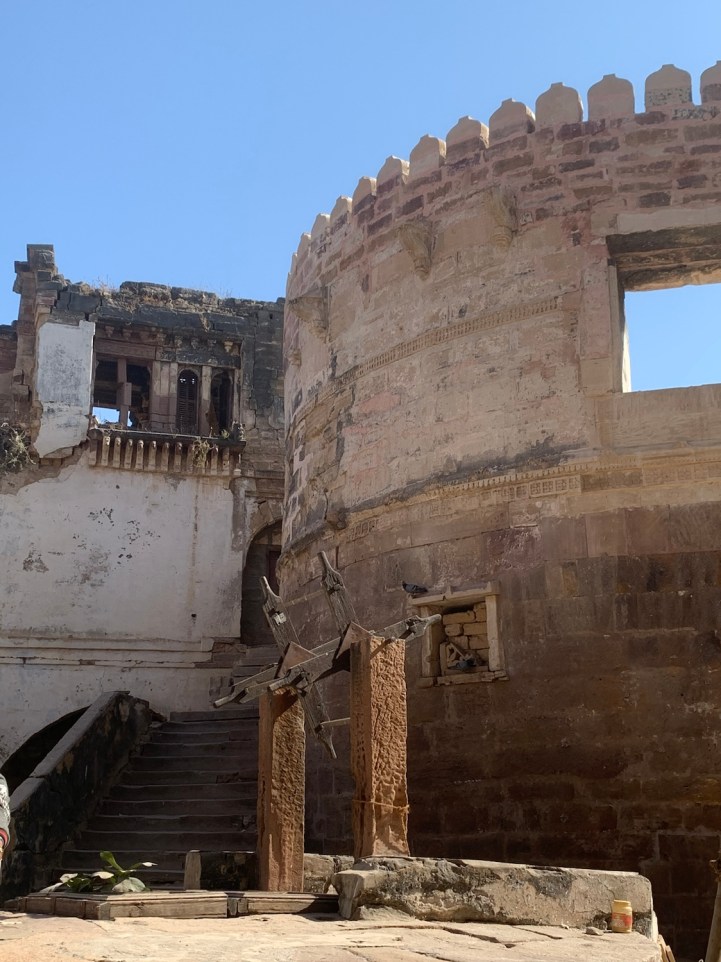
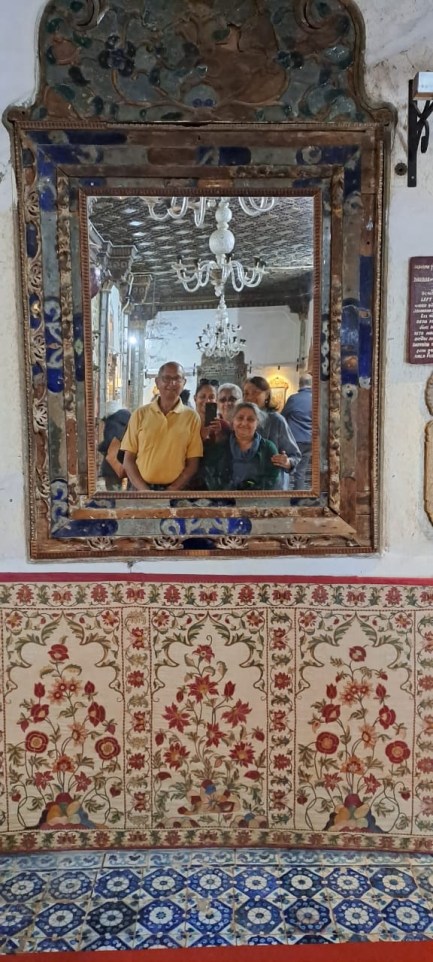
We began with the 18th century Aina Mahal which was once the residence of the Maharajas and now converted into a museum . Thanks to the 2001 earthquake, the upper story has fallen down but the palace still retains traces of its former glory and is currently being restored. We saw the Hira Mahal which was the king’s bedchamber with its low bed with gold legs ! Also displayed were the king’s possessions like the porcelain serving platters covered with broody hens as lids ! The central hall with its lights and chandeliers has walls lined with hand embroidered panels. The Delft tiles on the corridors, wooden fretwork and Venetian glass and mishmash of oriental and occidental paintings and artefacts creates a unique style that is opulent with a touch of whimsy.
Though the palace looked a wreck, from the inside one could see the remnants of a glorious past .
We re-visited the Kutch Museum which was closed on our first day and I’m glad that we saw it on our last day when all the exhibits made more sense .
The underground snake
According to one of the many legends that abound, Bhuj rests on the head of a snake. The first king who settled there was supposed to kill the snake with a smooth thrust of his sword but instead, he pulled it to check his aim. This unfortunately resulted in an injured snake still living underground. In yet another story, the snake is personified as King Bhujang and still lives below Bhujio Hill . A steep climb up this hill leads to a temple that people still go to.
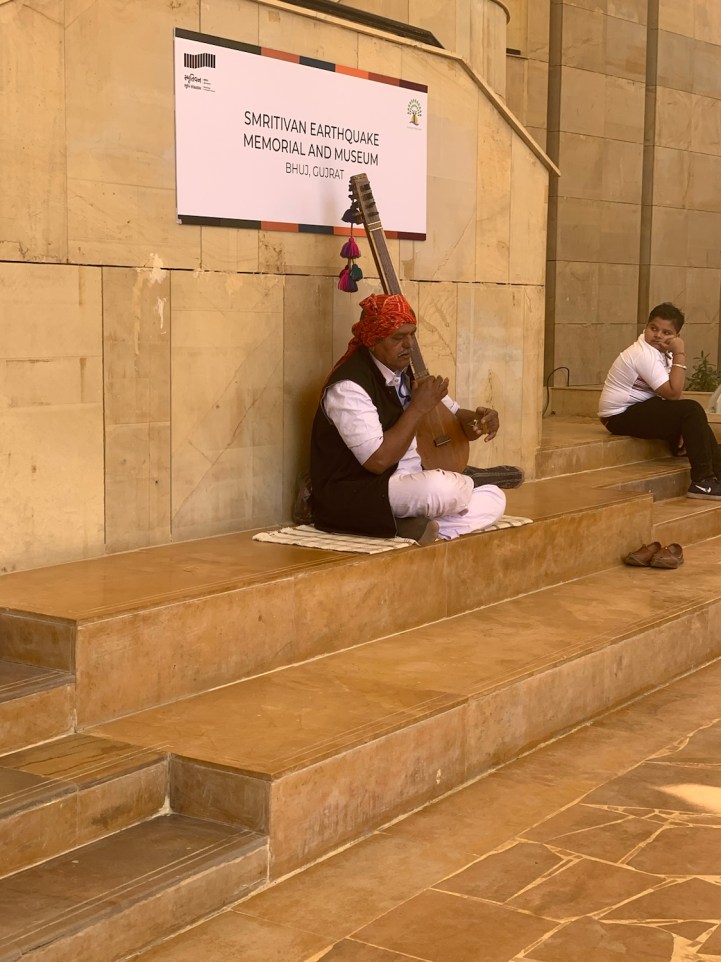
The writhing snake underground is represented by this imposing steel sculpture that decorates the bottom floor of the SmritiVan Museum.
The legend of the snake is depicted in the convoluted steel pipe sculpture on the ground floor of the spanking new SmritiVan , a museum commemorating the Bhuj 2001 Earthquake . The memory park with each tree marking an earthquake casualty and the backdrop of Bhujiyo hill is the perfect foil for the building that is a stunning piece of modern architecture. It is truly international in its construction and functioning.
After visitors buy their tokens , they have to wait a while for their guide who will take a group of 20 around through seven blocks. In the sixth gallery , visitors actually relive the horrendous 90 seconds that shook Bhuj. And in the last gallery visitors observe a minute’s silence while names of the dead flash up on the walls.
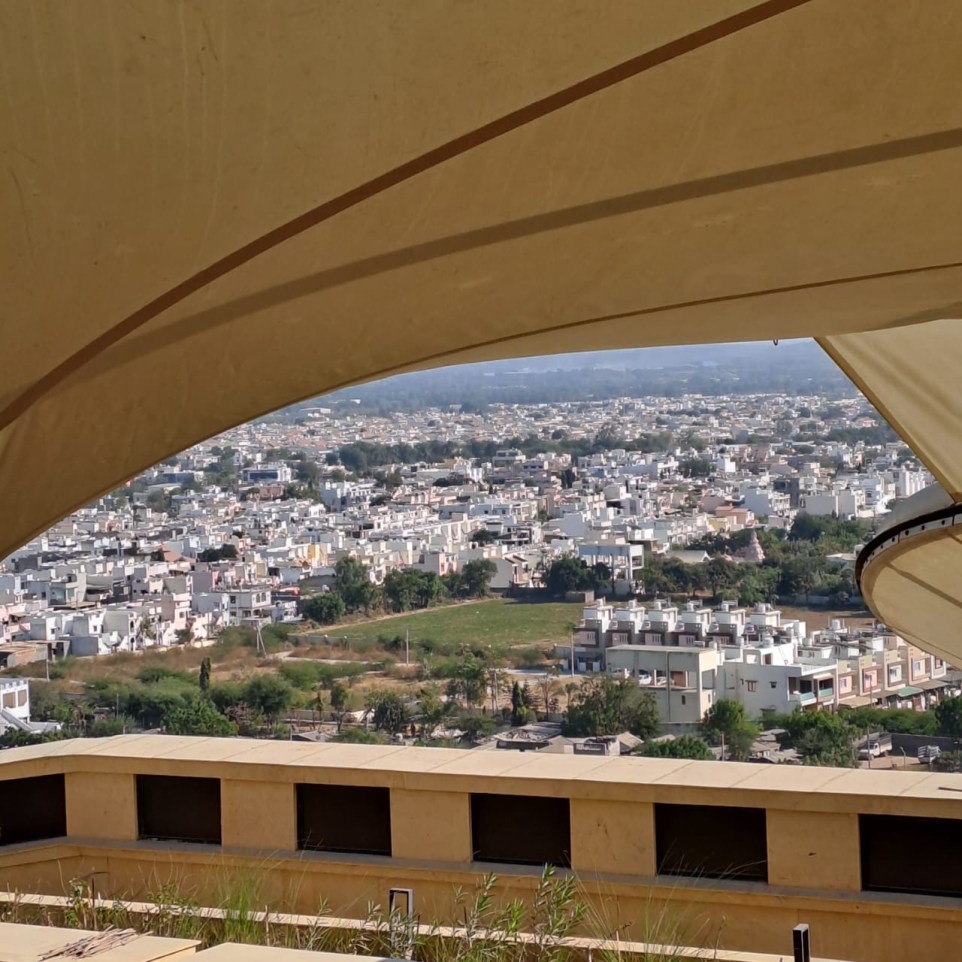
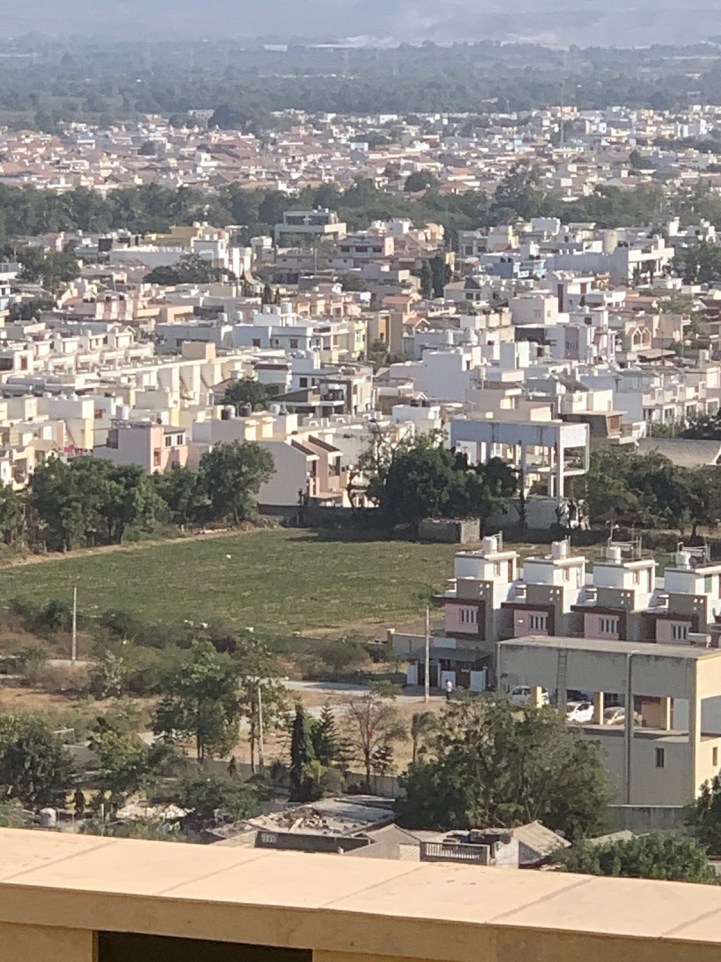
A local musician provided entertainment with live music while visitors waited their turn . The newly constructed city of Bhuj can be seen from the museum.
Reviving lost embroideries
The museum has a fine dining restaurant so we grabbed a quick bite before making our way to the last museum on our list :the ShrujanLLDC which is at Ajrakhpur on the outskirts of Bhuj. Started by Chanda Shroff way back in 1969, Shrujan is responsible for the revival and regeneration of the embroideries of Kutch that threatened to become extinct.
Photo from LLDC website used without permission
Photos of LLDC taken from Website without permission.
Woven skills of Bhujodi
The sun was setting and it was getting late but we made one last stop at Bhujodi a village that turned out to be a fabulous place to buy local embroidered and woven stuff as every home had its own hand weaving workshop ! It was too dark to take any photos but this little village is a shopaholic’s dream .
We visited the charming home of Vankar Vishram Valji who was about to shut shop for the day , but still showed us his fascinating weaves up for sale . The village house with its cow shed, open kitchen, looms and living space is truly the original work from home model.
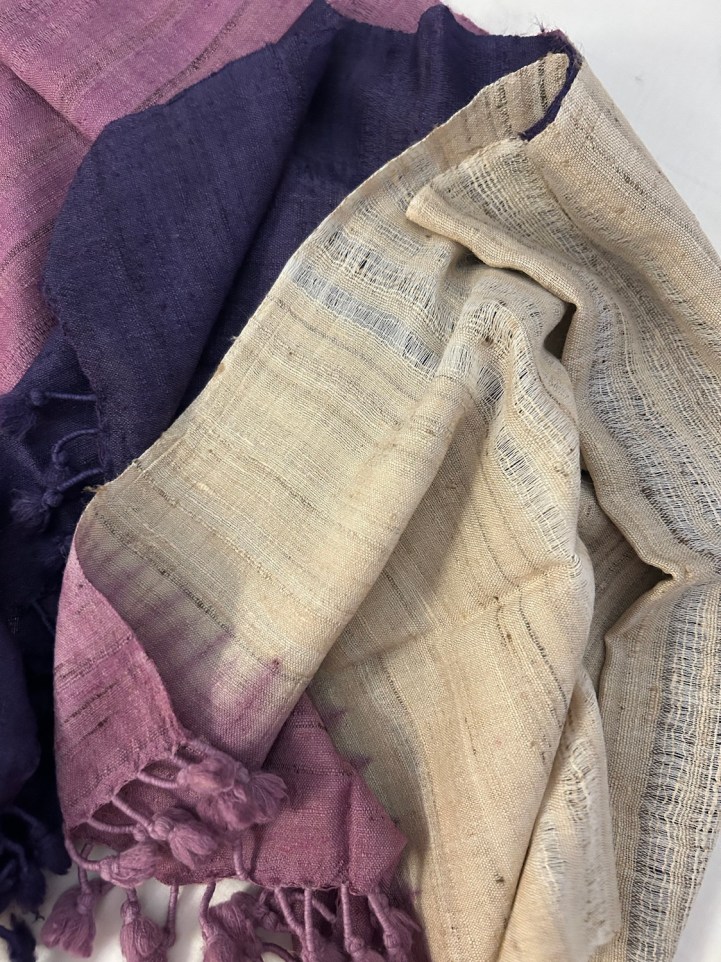
Having resisted the allure of Kutchi textiles , I finally succumbed on the last day and bought this gorgeous woven stole for myself .
Sweet memories
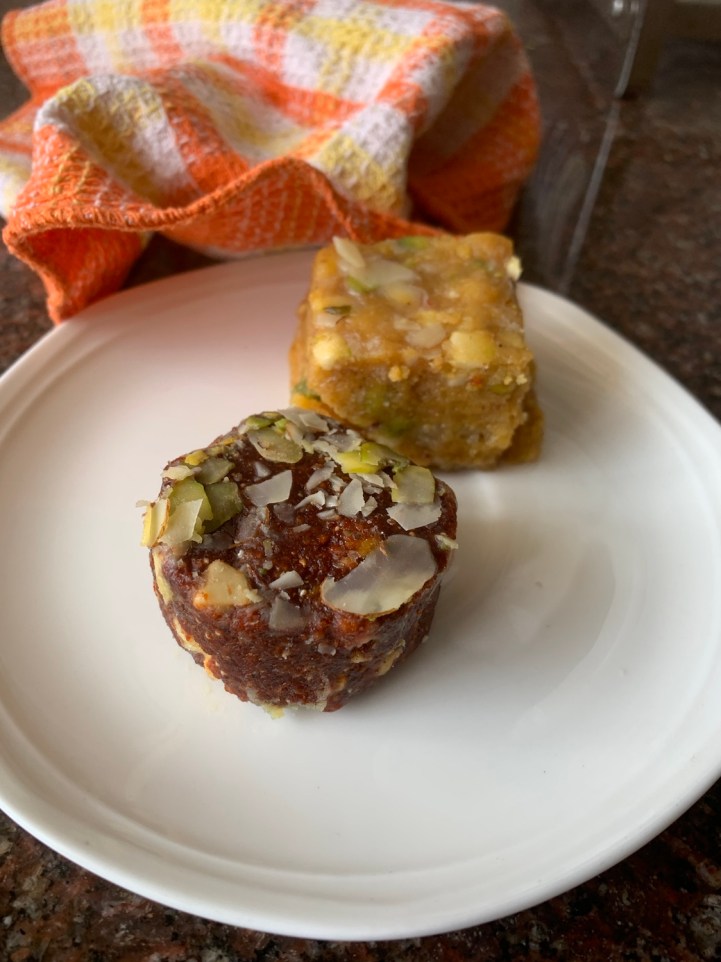
There was still one box left to be ticked – taking back a sweet memory of Bhuj. So Mr Mitul to took us to Khavda ( the famous sweet shop ) to buy some local delicacies. With Winter still in the air we bought the seasonal specialties.
Adadiya ( below ) and the Gundar Pak the Winter specials
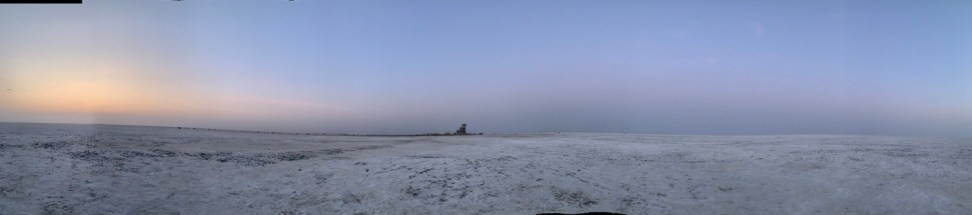
After the brilliant sunrise on the Raan we made our way to Kalo Dungar the highest point in Kutch before going to Dholavira.
We stopped at a Kharad ( carpet ) weaver’s home in Ratadiya village. Vegetable dyes are used to dye the wool from camels and goats used to weave the carpet. While carpets in this workshop are made to order, the weaver showed us his original pieces, some of which depicted everyday village life.
Up the down road
Did you know that in Kalo Dungar area there is a spot where the forces of gravity do not act ?
Just before Kalo Dungar we came to a magnetic zone where it seemed that the car rolled up the downward slope! Similarly we took turns in spilling some water in the middle of the road and watch it climb upwards instead of rolling down !
On the way up we saw a tempo load of people going up the steep hill, the old people looking decidedly petrified that they would fall off !
Atop the hill is a new temple built on the site of the old temple that was destroyed in the earthquake . Similarly, a few metres downhill is another modern structure that guards the eternal flame marking the spot where Dattatreya was said to have prayed .
Some distance away, there is a spot where the offerings made at the temple were left for the jackals to eat . Till a few years ago jackals did come to eat the Prasad.
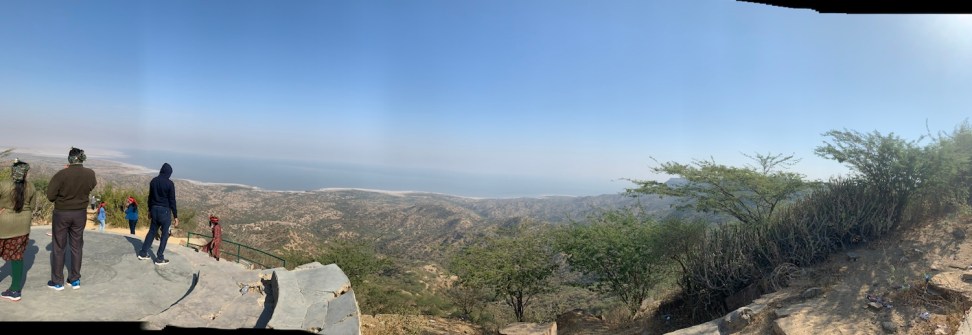
Standing at the highest point makes you feel you are at the edge of the world . With the vast landscape of hills, white sands of the Raan and Pakistan in the distance , you really get a feeling of awe.
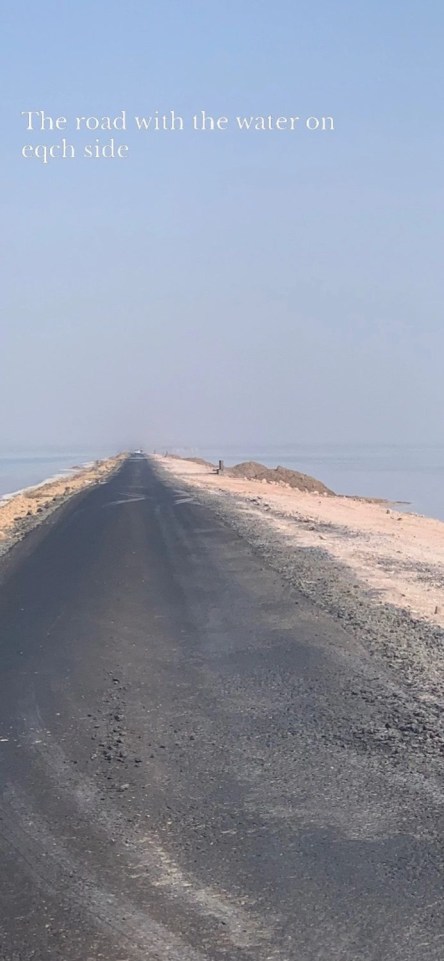
The road to Dholavira was magical. A straight tar road dividing the lake made created amazing landscapes with various hues of blue white and brown. Bits of salt crystals floated on top like the foam on a water body and it was hard to imagine that the lake was only a few inches deep .
Finally around lunch time we arrived at Dholavira which is an island in the middle of the lake. We checked in to our newly made bhungas .
After a quick lunch went to the UNESCO heritage sight to see the ruins of an ancient civilisation dating back to Harappan times.
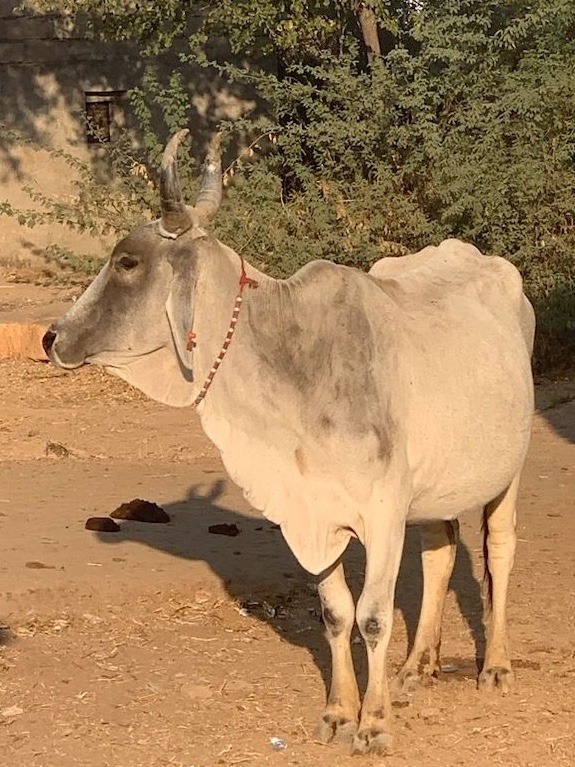
Our Bhunga for the night Doesn’t this cow look like the one on the Harappan seal ? A huge water reservoir A sewage opening The Royal jacuzzi and shower A stone stool, grinder and mortar
It was fascinating to see these excavations of a civilisation that once had a vibrant trade with Mesopotamia. Sadly the museum was shut so we had to rely on the local guide’s information .
Jurassic Park
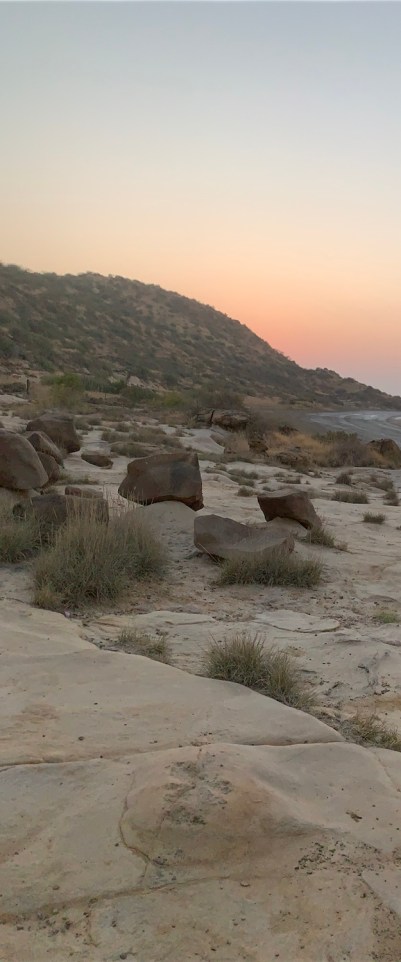
I didn’t quite understand what Mr Mitul meant by Dinosaur Park until we visited the Fossil Park. Flat rocks with interesting formations and a piece of petrified wood rendered this a place of undeniable beauty.
The fossil park with its specimens of petrified wood and fossils dating back to the Jurassic era is definitely worth a visit .
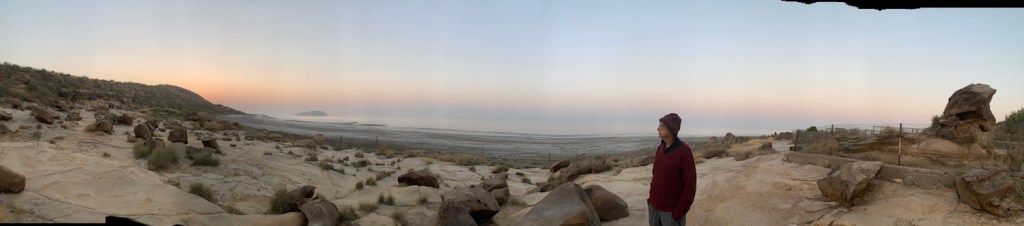
We watched the sun setting on the Rann for a bit before making our way back to the Bhunga for dinner. Before retiring to bed we sat in the open air listening to folk songs by the local artistes .
Tomorrow would be our last day and I was looking forward to more treats unfolding before we went back home .