
A Pilgrim’s Progress
I would be the last person on earth I would imagine as a pilgrim – especially the kind of pilgrim one sees on the Indian Pilgrim trail. I am neither old nor old fashioned but have an abiding interest in philosophy, religion and culture. Besides, I think there is something romantic about the word “Pilgrim” which is why I always wanted to be one.
 Almost two years to the day that we embarked on our Ashtavinayak Yatra, I finally made it! Of course the composition of the original pilgrims was vastly changed as was the route and means of transport but what matters is that eventually a long standing dream of mine was finally fulfilled.After much research, I found that the best way to do the trip was through Pune which somehow was a two day trip as compared to the Mumbai bound ones which turned out to be a three day affair. With the temples in far flung locations it made most sense to go in a conducted tour rather than on my own. So we narrowed down our choice to Prasanna Tours & Travels, which seemed the best decision. We opted for a weekday tour which is over Thursday and Friday rather than for the weekend one which would mean more crowds at the temples.
 So we set off at 7 from Shaniwarwada and made our way to Morgaon, the first of the Ganpati Temples from which the tour is supposed to begin. The sixteen seater bus had passengers whom you would definitely not see on a plane but nor were they the type who you would encounter in a State Transport bus. Apart from Mrs. Bhunbune and Mrs. Kurkure the rest of the passengers were quiet . Mrs. Bhunbhune who was a typically frizzy haired frazzled housewife wore her Orthopedic Belt round her waist like a Badge of Honour and entered the bus with a loud complaint – ” Oh my God! I’ve never travelled like this in my life. I hope somebody from one of the front seats exchanges a seat with me. I can’t travel sitting on the back seat!”.
It goes without saying that everyone stared stonily ahead completely ignoring this lament. Our tour guide as it turned out was no guide but a Tour Manager and apart from the rallying cry of “Ganpati Bappa Morya” and ” Mangalmurti Morya” which he cried out each time we alighted and set off, didn’t do any guiding. After handing us our bright yellow caps which he told us we had to wear every time we got off the bus, he inserted a disc which narrated the legends of the Ganpatis we were going to visit.
Lord of the Peacock Tradition decrees that the pilgrimage starts and ends with a visit to the Mayureshwar Temple at Morgaon a small town 55 km to the east of Pune. Passing through rural Maharashtra which is slowly getting urbanised, we soon reached Morgaon or Peacock Town so named because of the hundreds of peacocks that lived in this area. Alas! There is not a single peacock to be seen nor was it possible from afar to spot the four minarets around this temple that gave the impression of it being a mosque. But perhaps this ruse did serve to keep the Mughals at bay because the temple remained intact. As usual there were two legends associated with how this temple came to be, but the essence was that this was the place where Lord Ganesh came seated on a peacock hence he was called Mayureshwar or Moreshwar.
 We were told to buy just one coconut each and offer the same to all eight idols so that we went home with just one at the end of our journey. We got off the bus and bought our floral offerings and visited the temple. It was a beautiful and peaceful darshan. For some strange reason, circumambulating the idol in most temples these days is forbidden so we had to make do with just the one minute prayer before the idol . But we did participate in the aarti which brought back memories of several Ganpati Pujas in the past. After a tasty breakfast in the priest’s house we got back in the bus for the next temple.
This temple surprisingly has a large stone Nandi , the bull normally associated with Lord Shiva. It is said that the cart transporting this bull which was supposed to be installed in another temple, broke down and the Nandi refused to be carried away! So this is how the temple has a Nandi in its courtyard.
Vishnu’s enlightenment
 Siddhatek, or the hill on which Lord Vishnu attained enlightenment is situated along the banks of the River Bhima . Till a few years ago, this temple was accesses by boat but now of course there is a wonderful road which leads right up to the foot of the hill. In fact there is also a wonderfully paved track for the circumambulation .

Before visiting the temple, the pilgrim is required to visit the temple of Vishnu but our tour didn’t make any provision for this so we went straight ahead to the the temple of Siddhivinayak which was a little distance away.
This idol in this temple has the trunk turning to the right and is supposed to be the most powerful of all the Ashtavinayaks and a wish made here is bound to be granted – especially after doing the parikrama which is a 1 km walk around the hill. Not only was it high noon but time constraints also prevented us from doing this. So I will have to go once again to this temple to make sure my wishes are fulfilled!
Soon after we left the temple we stopped at Sai Shantai a roadside “hotel” which served us the most lip smacking vegetarian meal consisting of a curried vegetable, a daal, jalebis, chapatis, cooling buttermilk and jeera rice. It soon became apparent that this meal did not meet the approval of Mrs. Bhunbhune who once again made a plea for a change of seat – threatening to vomit if she didn’t.
” Her stomach is churning”, said her companion and niece Mrs. Kurkure, ” And if she throws up all the passengers will be inconvenienced!!!”
Needless to say, she didn’t throw up the entire trip.
Destroyer of all worries
 The temple at Theur is associated with the illustrious Madhavrao Peshwa who loved this temple so much that he spent his last few years in the comfort of its compound. He died young and his wife Ramabai went suttee with him, a fact which our tour guide alluded to in the most cavalier fashion” There’s the site where Ramabai went suttee,” he said nonchalantly waving in the direction along the banks of the River Mulamutha where you can see a small memorial marking the spot.
 Ganesh – the strong
 We crossed the river and drove past the city of Pune and joined up the Ahmednagar Road where the Mahaganpati of Ranjangaon is situated 50 km away from Pune.
Remover of all obstacles
In this temple at Ozhar, we find Ganesh as Lord Vighnewshar or the remover of all obstacles.


Day break at Lenyadri

 By night fall we boarded the bus yet again to make our halt for the day – Lenyadri. At the foot of this huge hill, we had a veritable feast at the Girija Hotel . The rest of the pilgrims were accommodated in a dormitory behind the Girija Hotel but we preferred to spend the night at Lenyadri International. This hotel is very basic despite its claim to being international but was comfortable nonetheless.
 As day broke we began the 307 step climb up the mountainside to visit the cave temple of Lenyadri. Lord Ganesh is acknowledged as the son of Parvati in this temple and is known as Girijatmaj. My mother of course wanted to climb yet another mountain but I didn’t want to risk it and insisted she take a palanquin. After several halts where I resorted to Pranayam to get my breath back, I reached the top to get the most fantastic view of the vast plains below.
  The climb didn’t stop there. We still had to negotiate a few flights before we could enter the cave. It seemed strange that this rocky mountain in the middle of nowhere had a temple dedicated to Lord Ganesh in an otherwise Buddhist Temple complex. But once inside, there was again a sense of peace .
Granter of all wishes
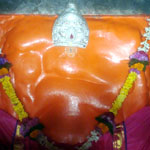
 We drove through the Deccan Plateau and down the hillroad crossing over the Expressway and on towards Khopoli. We had to take a turn off to reach the town of Mahad 6 kms away and 84 kms from Mumbai. This beautiful temple had an idol which we could actually touch – a most gratifying experience – and a lamp that has been burning continuously since 1892.
The temple of Balleshwar
 In the shadow of the Fort of Sudhagad, this temple is actually named in honour of Lord Ganesh’s devotee a young lad named Ballal and who was punished for worshipping him so.


