The initial start of our night halt at Shillong was a bit of a disaster.
It took us over an hour to travel the last km to the hotel which was situated right on top of the Bara Bazar. Hotel MCrown is beautifully located for those who want to see the bazar which is famous for its vendors who are solely women. But we weren’t really interested in the local market which seemed to have the standard stuff you find in all Indian street shops. Besides the market had many male vendors too so this was not an attraction anymore. Honestly, I would not recommend this hotel to those who want some peace and quiet. Moreover should you have no option but to stay here, I would strongly recommend arriving there during NON PEAK business hours because the traffic I experienced here was by far my WORST TRAFFIC EXPERIENCE ever.
The MCrown on the top floor of a shopping Mall ! By sunset the busy market wax almost emptyThe famous red chillies and more ! Roots and shoots and orchids too ! I thought this bank was a foreign bank till I realised it was my Bank of India write. In Khasi ! What was this man thinking of, making a terrace garden on a narrow roof top with no place to sit ? One of the few remaining old fashioned bungalowsThe sun set down on Shillong All Saint’s – the oldest church in ShillongView of Shillong
However, after the stop at Umian Lake ( Bara Pani) and the seven storey hike up the DonBosco Tribal Museum we were quite hungry and wanted to have a substantial local meal .
The girl in the front office of MCrown told us about the Trattoria a hole in the wall just around the corner.
And a hole in the wall it truly was. But it made for a fine dining experience. By the time we reached, most of the stuff was over so he gave us a Pork Combo where we literally pigged out on some local fare.
The menu , the smelly curtain Three abreast Airline style seating Recognising the eatery’s greatness The Pork Combo where we ate all kinds of pork including the brain ( according to Prima Donna) that I truly relishedThe cook who was thrilled to bits that we had come to experience the true taste of Khasi food.
The restaurant itself had three rows of seating facing one way only. Each row had two benches along the aisle and each bench seated three.
We made a cursory round of the Bazar since it was literally hugging the hotel but we’re quite unimpressed and scared of venturing deep into the crowd because of CoVid.
So luckily the early sunset made it easier for us to call it a day and we decided to loll around in bed and watch as much free TV as we could manage!
Ciao
P.s. the Don Bosco Museum of Indigenous Tribes is really a well-curated museum. It encapsulates the history and culture of the tribes of the North East. And the view from the top is worth the winding walk on the top of the roof!
Hotel Gateway Grandeur proved to be a disappointment. The beds were decidedly lumpy and the lurid red velvet bedspread, shabby golden lampshades and musty smell didn’t reassure us. But that didn’t dampen our enthusiasm to explore a little more of Guwahati before we set off for Shillong .
Our introduction to the North East began with a dinner cruise on the Alfresco Grand sailing down the Brahmaputra. While we sailed, we were entertained by the Bihu Dancers . We also got a run down on the brief history of Assam , the legendary warrior Lachit Bhorpukan and the different musical instruments used in Assamese folk music.
Enjoying the cool breeze and escorted by the twinkling lights on the shore listening to old Hindi film songs we sat on the upper deck while down below the cooks were getting our dinner ready.
Where are the fish ?
Once again we were disappointed with our meal of chicken makkhan wala and pasta in white sauce. Surely we’d get a flavour of the local cuisine ? The only nod to local food was the ingredients that were locally obtained and of course the fish that was unique to the region.
So the next day, on our way out to Shillong, we insisted Anil take us to the local fish market , especially as he pointed out the fish vendors on their brightly coloured rickshaws doing their delivery rounds.
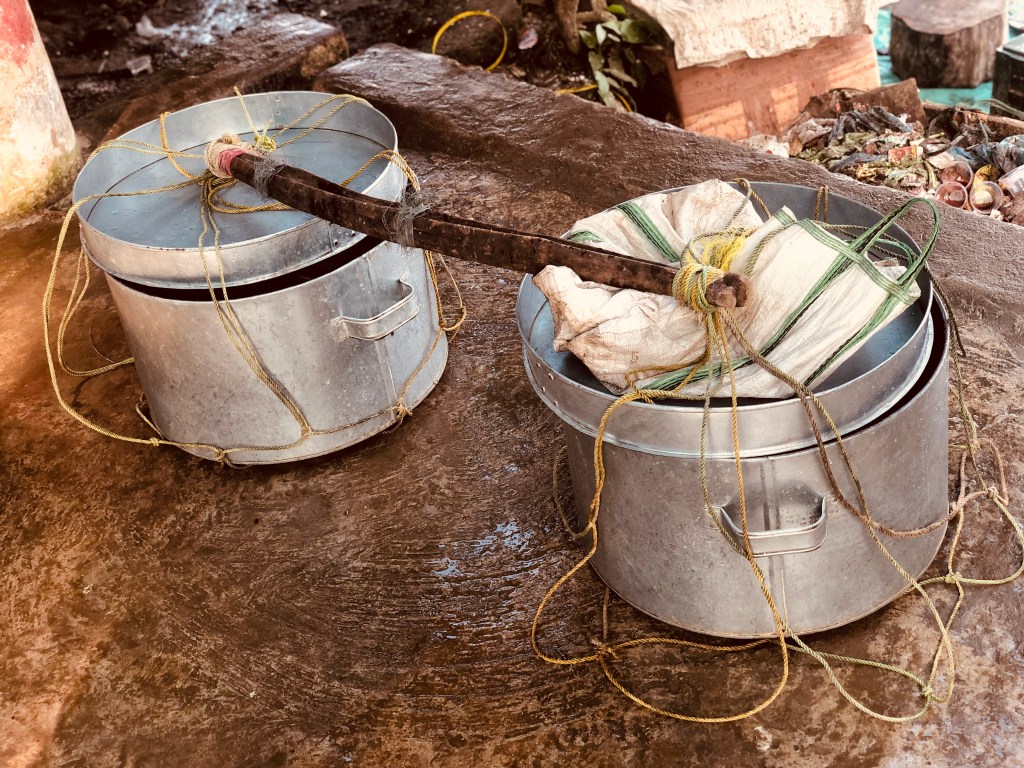
He was a bit taken aback by our request to visit the fish market but gamely came along and even identified some of the fish that were swimming in the huge tubs that are used to transport them for door to door delivery!
Set on a small strip of riverbank, at 7am the market was ready to wind up with most of the auctions already long over. But we still managed to see some vendors haggling with their customers and had a brief glimpse of the fish market .
Fishermen winding up for the day after offloading their catchTiddlers swimming aroundTwo large aluminium cans in which the live fish are carried door to doorThe fish sold in this marketFresh water prwns are really very tastyA customer buying his fishIsn’t this a colourful rickshaw to travel in?One of the rare fish not swimming in a watery container
After the fascinating trip to the fish market, we set off on the long road to Mehgalaya.
We didn’t see much of Guwahati as it was dark by the time we reached and too early when we left, but what impressed me most were the skywalks! They looked so slick and stylish compared to the ugly structures that dot Mumbai’s roads .
On our way
Did you know that at one point , the states of Meghalaya and Assam are separated by just a road divider?
So while cars going one way are driving in Assam, the cars going the other way are driving in Meghalaya.
The pineapple was rounded and soft and velvety without a hard core or fibrous pulp. And the vendors cut them into bite sized pieces and dusted them with a coating of salt and red chilli powder which added a little zing to the fruit .
We came across many small farmers selling their wares in roadside stalls. What was most popular were jars of pickles ( the famed Assam chillies and pork) the local betel nut and of course the Pineapples which Anil insisted we try.
And he was right.
Honestly, I have never eaten such a sweet pineapple before!
From time to time Anil would put some stuff into his mouth and spit it out a few hours later. I wondered if it was gutkha but he assured me it wasn’t.
And when we stopped for our pineapple break, he pointed out to the betel nut that he used to chomp on.
It was the local betel nut that Assam is famous for and I asked the vendor to give me a pinch to try but she refused saying that “If you’ve never had it before, it will be too strong for you to handle” and she gestured me going off the rails with a wave of her hand.
But I was convinced that there was more to the Betel nut than meets the eye because the next day at Elephant Falls, another taxi driver literally pleaded with him to share some of his betel nut with him.
Our entry into Meghalaya was more dramatic than expected because of the new rules thanks to CoVid. We were stopped at the border crossing and asked to show our double vaccination certificates and an E-Invite by the Tourism Board of Meghalaya!
Luckily the smart BSF women who were manning the post helped us download the App and get the required permissions so that we could continue unhindered till Anil’s breakfast stop.
Miles and miles of lush green landscape make the long drives thoroughly enjoyable
Almost immediately the sky turned bluer and the countryside cleaner, the air crisper as we entered Meghalaya.
Another thing we noticed was the predominance of female labour. The hill tribes of Meghalaya particularly the Khasi are matriarchal.
As a matter of fact, I was surprised to see a newspaper report of an agitation demanding an amendment to the Succession Act to include male descendants.
Despite the long journey ( 4 hours and 99 km) the pleasant scenery of bamboo forests, tiny stalls on the road selling local produce and the conifers that announced the hill station of Shillong distracted us. We could have made it shorter if we hadn’t made stops along the way.
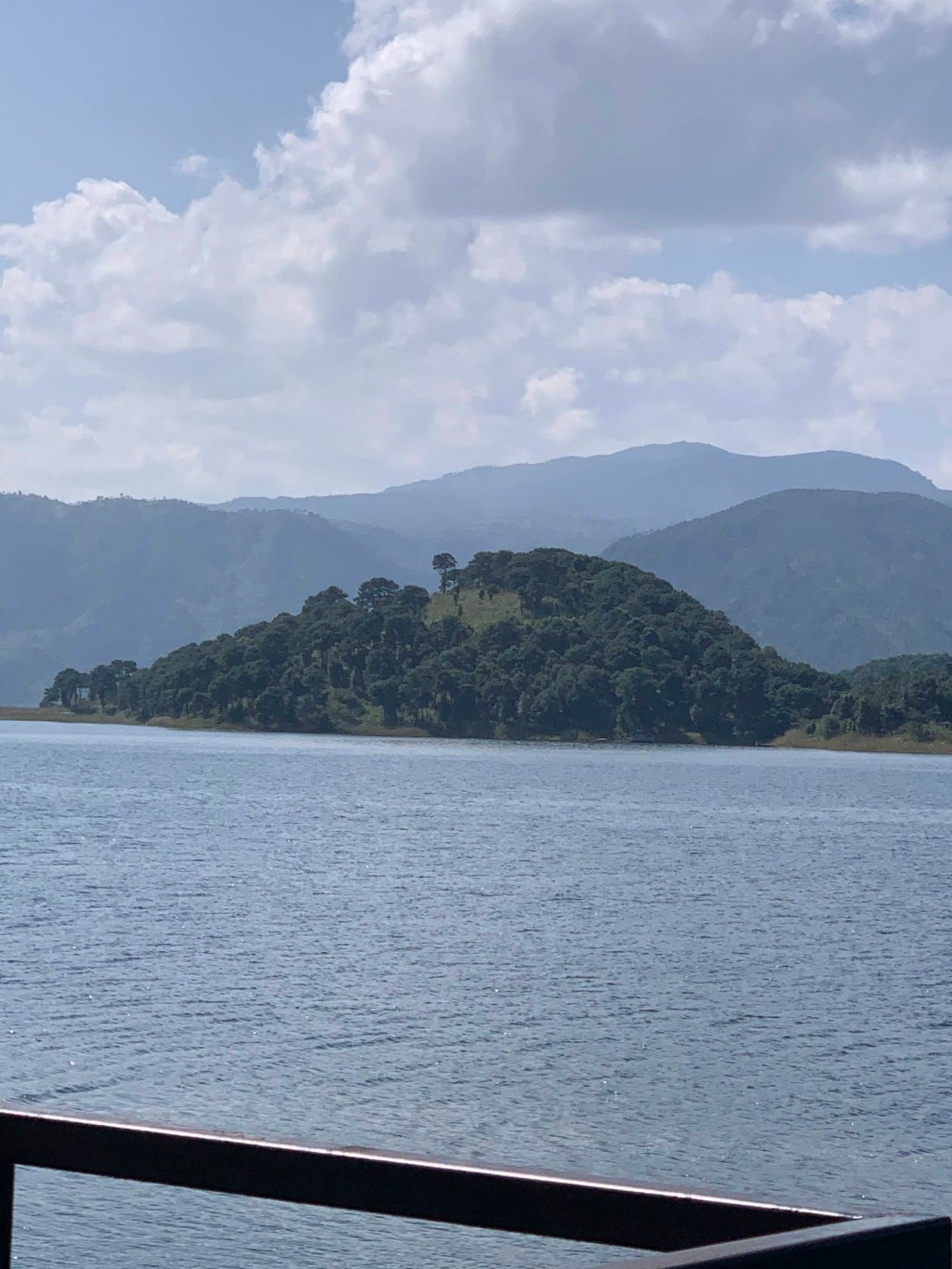
Bara Pani or Umiam Lake an artificial water body for rainwater harvesting along the way is a must-stop even if it is just to stop and stare.
Shillong was touted as Scotland of the East and possibly it was during its heydays. Sadly today, it has lost much of its old-world charm and glimpses of its glorious past can only be spotted in a few houses that haven’t given way to modern concrete monstrosities and the Cantonment area where military establishments still retained their old colonial heritage.
Even though a holiday was not on the cards, I was always fascinated by the North East and was glad of the opportunity to refresh my memories of verdant fields, lush forests, delicious pineapples and gorgeous wild rhododendrons.
Our driver Anil who had decided to take the long and scenic route to avoid the traffic did not account for the two Railway Crossings en route. I felt a jolt of familiarity as I spotted the long-forgotten road sign and my heart thundered along with the train as it sped past.
A large number of concrete buildings and several car dealerships lining the road leading to the city was a sure sign that the city was growing but what really impressed me were the amazing skywalks that were slick and extremely user friendly.
I was impressed with these skywalks that were accessible by both stairs and escalators . They were good to look at and easy to use . Despite Prima Donna’s insistence on a chicken wrap Immediately , the waiter insisted on handing it only when it was “gorom, gorom”The sign in the elevator that brought a smile
Sadly, I was misled by the wonder of the skywalk and was terribly disappointed with the hotel :The Gateway Grandeur was far from grand. It looked more like a grande dame who was tottering on her last legs. Predominantly red, with furnishing that had seen better days, I was glad that we were there for just the night .
Anil who was representing our tour operator Mr Rajkumar of Kaziranga Travels mumbled that we had to be ready by 5.30 so that we could catch the Brahmaputra river cruise organised on the Alfresco Grand. This was undoubtedly the redeeming feature of the day.
Would I return home as a dead body or a happy traveller?
At the Jahaz Ghat, we met the mysterious Mr Raj Kumar who welcomed us with the traditional Gamosa, a rectangular white cloth red woven borders on the side . As we sat on the deck of the boat, Raj Kumar and regaled us with stories of his clients: the story of how he shipped home the body of a dead tourist failed to bring a smile to our faces and which actually chilled me to the bone.
The Gamosa with an intricate woven border on the side .
Though it was pitch dark and we couldn’t see any sights on the river banks we were entertained by a troupe of dancers who performed the Bihu dance.
We also watched a short presentation of the story of Lachit Borphukan, the brave Assamese warrior who stopped the mighty Mughal armies from claiming the North East as part of their empire.
The short audio visual on board is both informative and entertaining.
And enjoying the slight breeze, listening to old Bollywood songs while we sailed along the Brahmaputra, we officially began our trip